Founder Types
What Is an ORVIT Founder Type?
If you have opened ORVIT and seen a two-word label attached to your name — Steady Order, Bold Ignition, Electric Breeze — that is your Founder Type. This is what it is built from, what the five sections mean, and, just as importantly, what it is not.
Every framework that puts people into categories owes you an explanation of where the categories come from. Most of them do not give one. This is ours, including the parts that argue against taking it too seriously.
What is an ORVIT Founder Type?
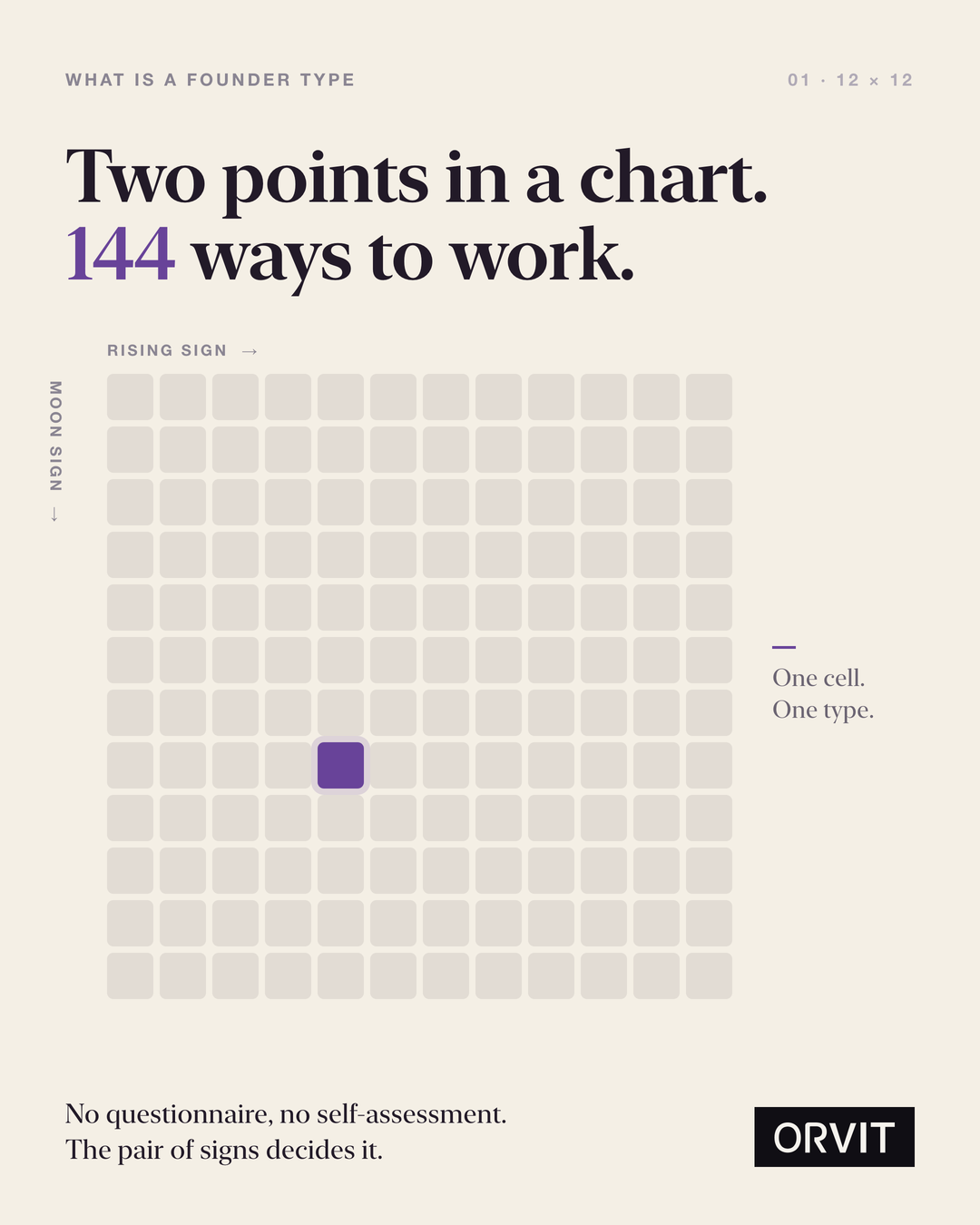
An ORVIT Founder Type is a work-style profile built from the combination of your Rising sign and your Moon sign. There are 144 of them — twelve Rising signs times twelve Moon signs — and each one has a name and describes how a person tends to communicate, decide, lead, execute, and move ideas forward with other people.
Inside the app it is called your Star Type. Founder Type is the same profile, named for the context most ORVIT members are using it in: deciding who to build something with. You can see all 144 Founder Types without an account.
The one-line version: a Founder Type is a description of how you tend to work with other people, derived from your Rising and Moon signs, meant to start a conversation — not to score you, rank you, or predict whether a partnership will work.
How is a Founder Type calculated?
Two points from your birth chart, and nothing else. Your Rising sign sets the outward half of the profile, your Moon sign sets the internal half, and the pair resolves to one of 144 named types. No questionnaire, no self-assessment, no scoring.
ORVIT requires only a birth date, and treats birth time and place as optional — you can create a profile and use the app without them. But be aware of the trade-off: without a birth time, your Rising sign cannot be placed precisely, and the outward half of your Founder Type becomes a guess. If you know your birth time, it is worth entering.
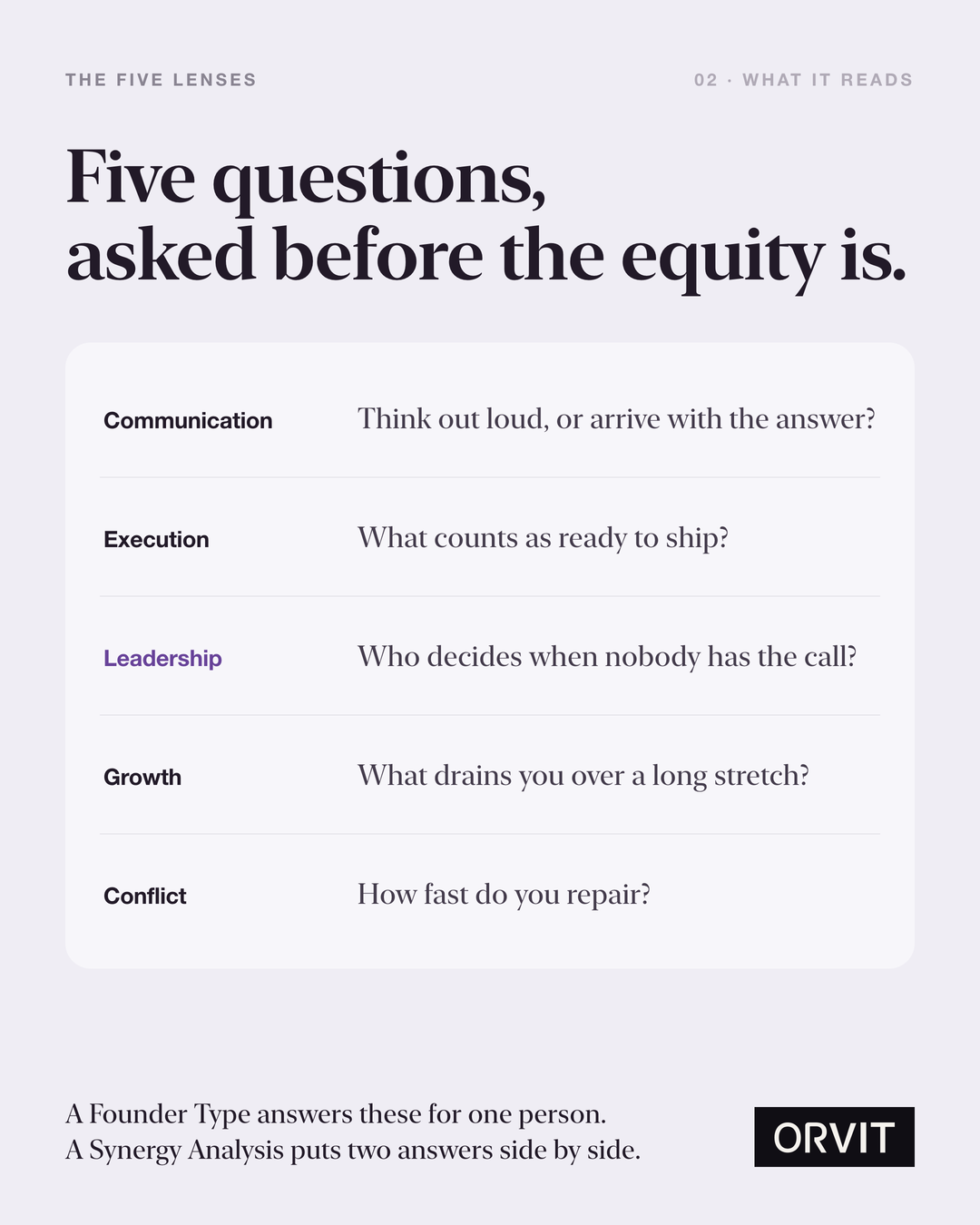
What are the five collaboration lenses?
A Founder Type is not one paragraph about your personality. It is a read across five specific areas of working together — the same five a Synergy Analysis uses when it compares two people.
These five are the reason the framework exists in this shape. They are the areas where cofounder relationships actually break, and they map directly onto the seven areas in our cofounder compatibility checklist.
What a Founder Type is not
This part matters more than the definition. A framework used for the wrong decision does more damage than no framework at all.
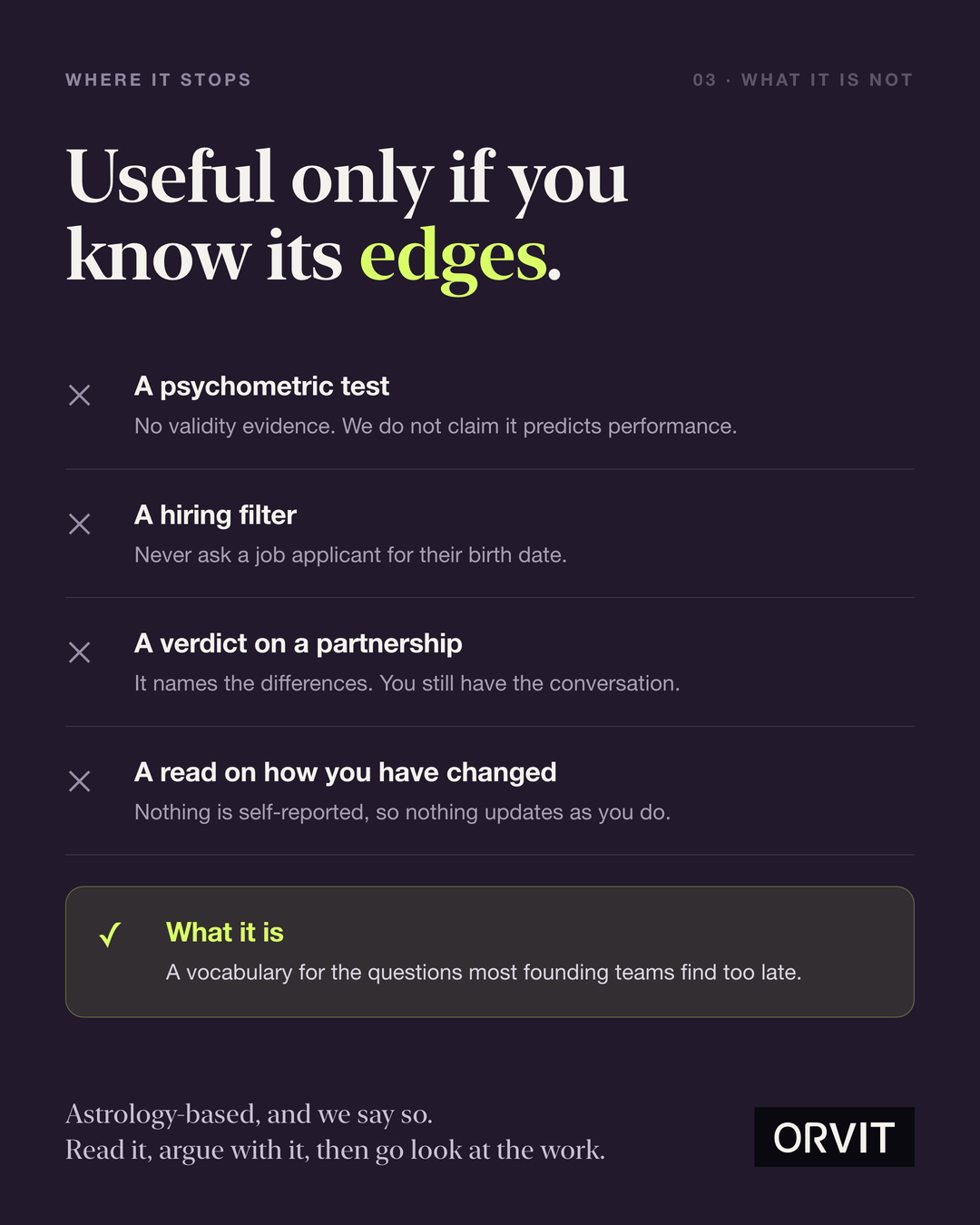
It is not a psychometric test
ORVIT is an astrology-based product and says so plainly. A Founder Type is not validated against work outcomes, it has no reliability coefficient, and we do not claim it predicts performance. If you need an instrument with published validity evidence, this is not one.
It is not a hiring or screening tool
Do not use a Founder Type to filter candidates, and do not ask a job applicant for their birth date. It is built for two people who have both chosen to look at how they work together — not for one person to evaluate another.
It is not a verdict on a partnership
There is no good match and bad match output. A Synergy Analysis names where two working styles may reinforce each other, where they may complement each other, and which differences are worth discussing early. The differences it flags are inputs to a conversation you then have with an actual person.
How is it different from MBTI, DISC, or the Enneagram?
The most useful difference is the input. Every widely used work-personality framework asks you to describe yourself; ORVIT asks you for a birth date. That removes self-report bias and introduces a much larger objection in its place.
We went through the MBTI comparison in more depth, including what its publisher says about using it on teams, in Founder Type vs MBTI for Teams.
We are not going to argue that the last row beats the first three on rigor. It does not. What it does offer is a starting point that takes thirty seconds instead of thirty minutes, arrives before the first call rather than after, and does not let either person quietly answer as the version of themselves they would like to be.
Why frame work chemistry this way at all?
Because the failure mode is well documented. In CB Insights' 2021 analysis of 111 startup post-mortems, "not the right team" was named in 14% of failures — one of the twenty most common causes, and the only one on the list that is entirely about the people. Noam Wasserman, drawing on data from roughly ten thousand founders in The Founder's Dilemmas, has attributed around 65% of failures among high-potential startups to conflict between cofounders.
Founding teams rarely collapse over strategy. They collapse over pace, decision rights, and what each person does when the other one is wrong — the things nobody schedules a meeting about. A Founder Type is a way to put those on the table in week one, when they are still cheap to discuss.
How do you use one with a potential cofounder?
The profile on its own is trivia. It becomes useful the moment two people compare theirs and talk about the gaps.
- Read your own type first and mark what is wrong — a framework you can argue with is more useful than one you accept
- Run a Synergy Analysis and look only at the differences, not the overlaps
- Turn each flagged difference into a question, not a conclusion
- Ask the questions during real work, not over coffee — a two-week trial project tells you more than any profile
- Keep what the work confirms; throw out what it contradicts
If you want the questions already written out, we grouped thirty of them by area: 30 questions to ask a potential cofounder.
Questions people ask
What is an ORVIT Founder Type in one sentence?
It is a work-style profile built from your Rising sign and your Moon sign that describes how you tend to communicate, decide, lead, and execute with other people.
How many ORVIT Founder Types are there?
There are 144 — every combination of 12 Rising signs and 12 Moon signs. All of them are listed publicly on the ORVIT Founder Types page.
Is a Founder Type the same thing as a Star Type?
Yes. Star Type is the name used inside the ORVIT app, and Founder Type is the same profile described in a work context. They refer to the same 144 combinations.
Do I need my exact birth time to get a Founder Type?
No. ORVIT only requires a birth date, and birth time and location are optional. But your Rising sign changes roughly every two hours, so without a birth time it cannot be placed precisely and your Founder Type will be less specific.
Can a Founder Type tell me whether someone will be a good cofounder?
No. It is not a hiring assessment, a score, or a prediction. It gives you a vocabulary and a set of questions for the conversation. Skills, references, shared goals, and real trial work still decide it. More on the boundaries in the FAQ.
The short version
- A Founder Type is a work-style profile from your Rising sign × Moon sign — 144 in total
- Star Type is the same thing, named for inside the app
- It reads across five lenses: communication, execution, leadership, growth, conflict
- Birth date is required; birth time makes the Rising half precise
- It is astrological, not psychometric — a prompt for conversation, not evidence
- Never use it to screen a hire, and never let it outrank what you see in real work
Find your Founder Type
See how you tend to communicate, decide, lead, and execute — and how that meets a potential cofounder.
Get ORVIT