Compatibility
Astrology Compatibility, Applied to Work
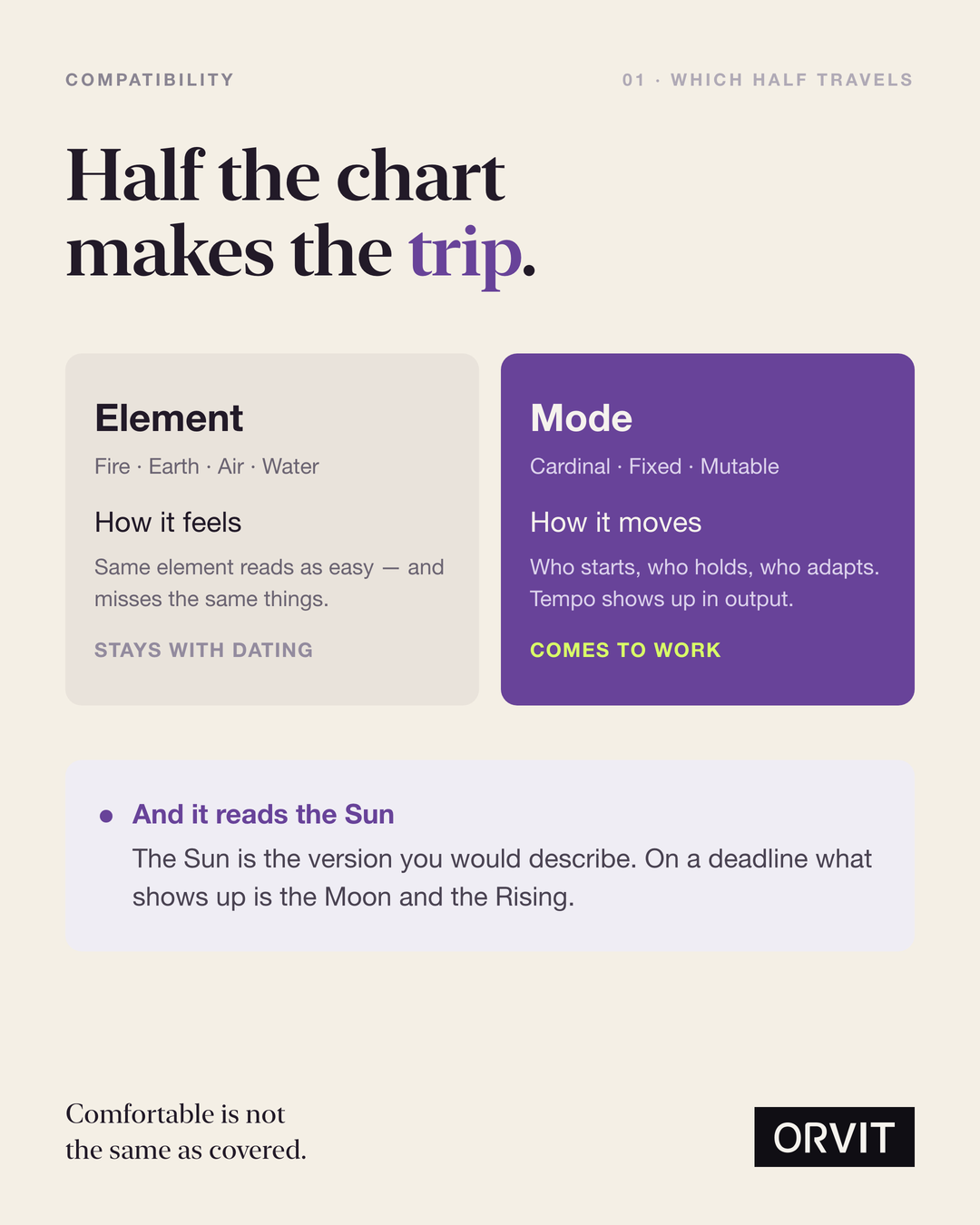
Search for astrology compatibility and nearly everything you find was built for dating. The element pairings, the best-match lists, the percentage scores — all of it answers one question: will we get along? At work that is the wrong question, and you can answer it correctly and still end up with a team that never ships.
This is not an argument that the charts are useless. It is an argument that half of what they measure transfers to work and half of it does not, and that almost nobody tells you which half is which.
What a compatibility chart is actually measuring
Two things, underneath all the styling.
Element. Fire (Aries, Leo, Sagittarius), earth (Taurus, Virgo, Capricorn), air (Gemini, Libra, Aquarius), water (Cancer, Scorpio, Pisces). The traditional reading: same element is easy, fire–air and earth–water are complementary, and the rest carries tension.
Mode. Cardinal signs (Aries, Cancer, Libra, Capricorn) start things. Fixed signs (Taurus, Leo, Scorpio, Aquarius) hold them. Mutable signs (Gemini, Virgo, Sagittarius, Pisces) adapt them.
Dating charts lean almost entirely on the element half, and for dating that is a defensible bias — element is about temperature, about how a conversation feels while you are in it. Mode is about tempo, and tempo is the half that matters once there is work on the table.
Why the easy answer is the wrong one at work
"Same element, so we are compatible" is a claim about friction, not about output. Two people who find each other easy will have a pleasant quarter — and they can have a pleasant quarter while walking into the same wall.
We wrote this in which founder types clash and it is the same shape here: the failure mode is not friction, it is the agreement nobody examined. Two earth-sign founders agreeing that the launch needs another month will agree sincerely, and nothing in the room is positioned to ask whether the month is real.
In one line: comfortable is not the same as covered.
Dating reads the Sun. Work does not.
Here is the part that gets left out. Compatibility charts are Sun-sign charts. The Sun is the closest thing in a chart to the version of yourself you would describe out loud — the one you recognise, the one you would put in a bio.
That is a reasonable thing to match on when you are deciding whether to see someone again. It is a poor thing to match on when a deadline lands on a Thursday, because the part of you that shows up on Thursday is not the described version. It is the reflex — which is the Moon — and the way you walk into the room — which is the Rising sign.
This is why ORVIT builds its 144 Founder Types from Rising × Moon rather than from the Sun. Not because the Sun is wrong, but because it answers a question nobody at work is asking.
The half that does transfer: mode
Mode survives the move from dating to work better than element does, because tempo is visible in output. Read these as questions, not as scores.
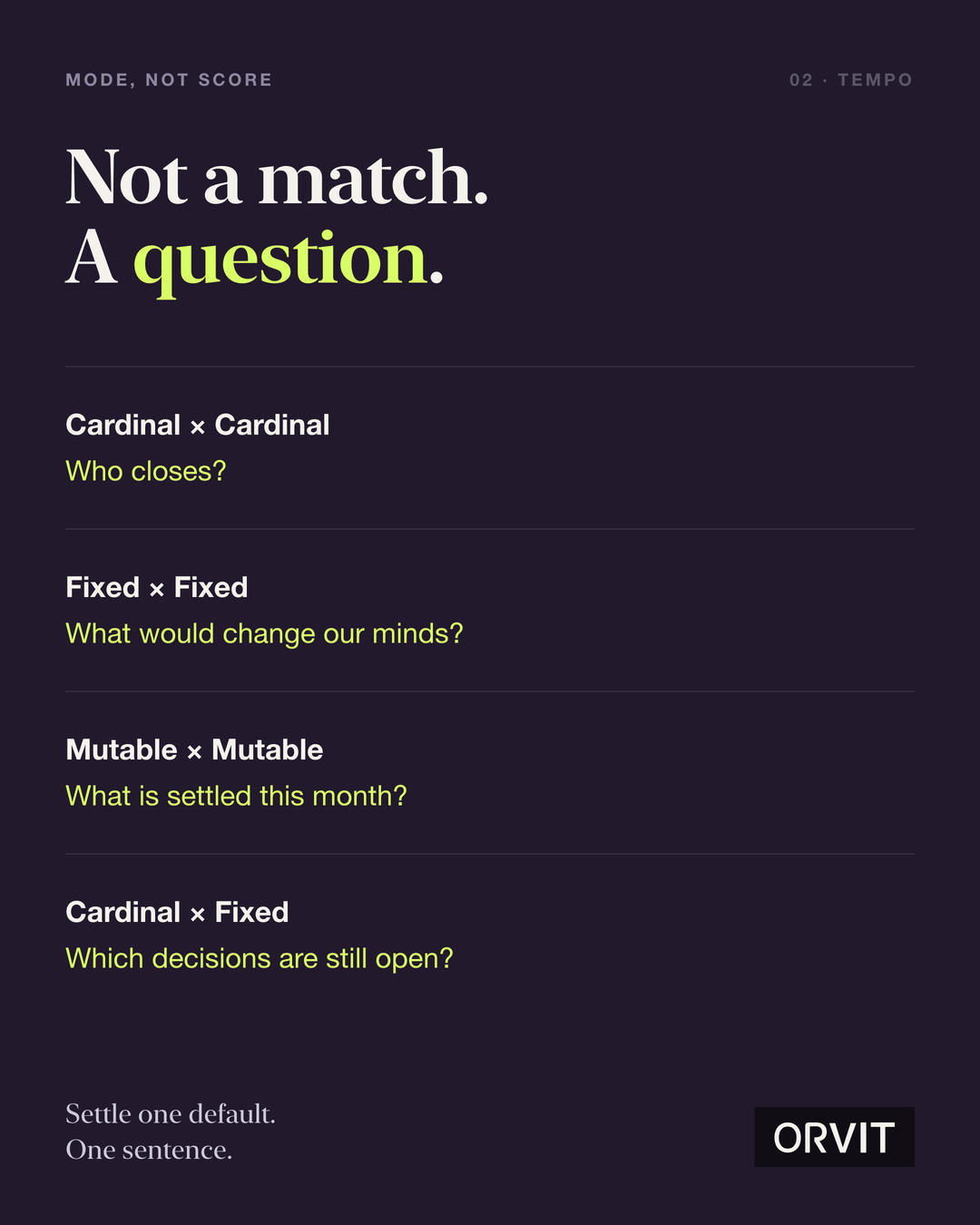
Notice what none of these rows say. None of them says do not work together. Each one names a specific thing to decide in advance, which is the only use a pairing has ever reliably had.
What "compatible" should mean once there is work
Not we get along. Try this instead, in two parts:
- Do we cover each other? Different mode, different tempo — one of you will notice the thing the other structurally cannot.
- Do we know where we do not? Where you match, you are fast and blind at the same time. That is fine as long as it is written down somewhere.
A pairing that scores badly on a dating chart can be excellent on both counts. A pairing that scores perfectly can fail both.
What to actually do with it
- Read the mode question, not the match score. "Who closes?" is answerable this week. "Are we a 78% match?" is not answerable at all.
- Look at Moon and Rising before Sun. If you only know your Sun signs, you know how you each describe yourselves, which is the least contested information available.
- Use it to open the conversation, never to pick the person. Nobody should decline a cofounder over an element. The cost of that mistake is invisible and permanent — you never find out what you passed on.
- Write down one default you now know you disagree on. One sentence. That is the entire return on reading this.
Where we stand, and what we will not claim
ORVIT is an astrology app built for work rather than dating — it reads Rising and Moon as a working style. What we do not publish is a compatibility score, and this article is the reason. A score would have to assert exactly what nobody has established: that one pairing produces better outcomes than another. No study has shown that.
What we will say is narrower and holds up: a pairing is a reliable way to find the conversation you have been avoiding.
Questions people ask
Does zodiac compatibility work for business partners?
Not as a prediction. No study has shown that any sign pairing produces better outcomes at work. What a pairing can do is point at tempo — who starts, who holds, who adapts — and that is a conversation worth having.
Are two people with the same sign compatible?
They are comfortable, which is a different thing. Same element means conversation feels easy and both of you miss the same thing, with no friction to warn you.
Why not just use Sun signs?
Because the Sun is closest to the version of yourself you would describe out loud. Under a deadline, what shows up is the reflex — the Moon — and the approach you walk in with — the Rising.
So what should I actually look at?
Mode for tempo, Moon for how someone reacts under pressure, Rising for how they open. Then go and decide one default together, in writing.
The short version
Compatibility charts are built for dating and read the Sun, which is the version of you that you would describe rather than the one that shows up on a deadline. Element tells you how it feels; mode tells you how it moves — and mode is the half that survives the trip to work. Same element is comfortable, not covered. Look at Moon and Rising, read the mode pairing as a question about tempo, and use the answer to settle one default in advance instead of to decide whether to work with someone at all.
See how you and your partner actually work — 144 Founder Types from Rising × Moon, no account needed.