Moon Sign
Your Moon Sign at Work
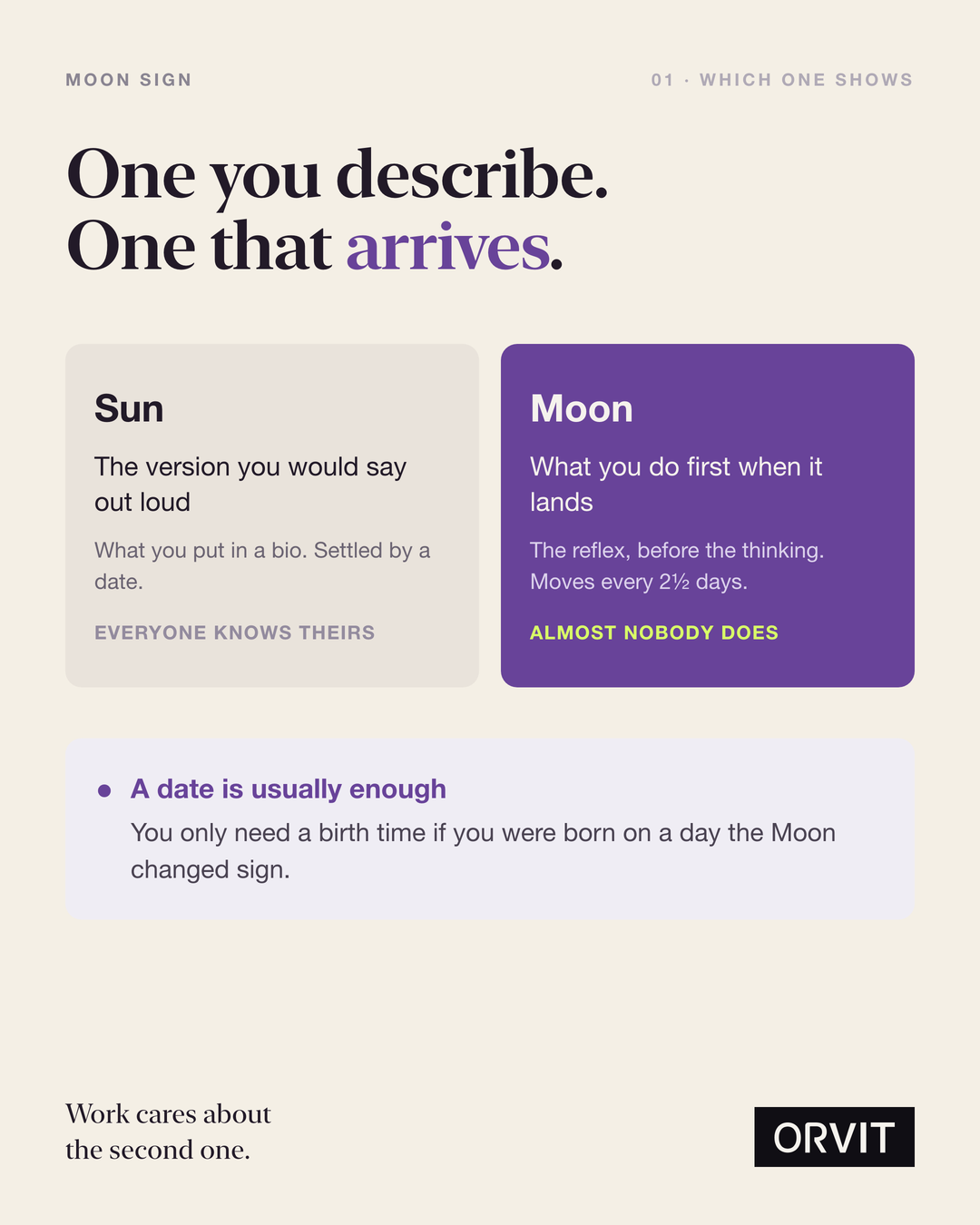
Almost everyone knows their Sun sign. Almost nobody knows their Moon. At work that ratio is backwards, because the Sun is the version of you that you would describe to someone — and the Moon is the one that arrives when a deadline lands on a Thursday.
We said this in passing in astrology compatibility applied to work: dating reads the Sun, work does not. This piece pays that off on the Moon half — how to find yours, what all twelve do under pressure, and what the placement does not tell you.
How to find your Moon sign
You need your birth date. You need your birth time only if you were born on a day the Moon changed sign.
The Moon moves faster than anything else in a chart — it crosses a sign in roughly two and a half days. That is slow enough that a date usually settles it outright, and fast enough that if you were born on a changeover day, the hour decides which of two signs you get. Any birth-chart calculator will tell you, ORVIT included. If it returns two possibilities, that is the changeover case, and you need the hour.
Rule of thumb: Sun needs a date. Moon needs a date, and an hour only on changeover days. Rising needs the hour, always.
Why the Moon is the one that matters at work
Because the question at work is not who are you. It is what do you do first — when the deploy fails, when the meeting turns, when the number comes in low. That first move is not considered. It arrives before consideration does, and it is remarkably consistent across years.
That is the part a Moon placement describes. Not your values, not your skills, not your ceiling. The reflex, and the conditions that keep the reflex from becoming the whole day.
The twelve, under pressure
Read the right-hand column as carefully as the middle one. The middle column is what happens; the right column is what you can actually do something about.
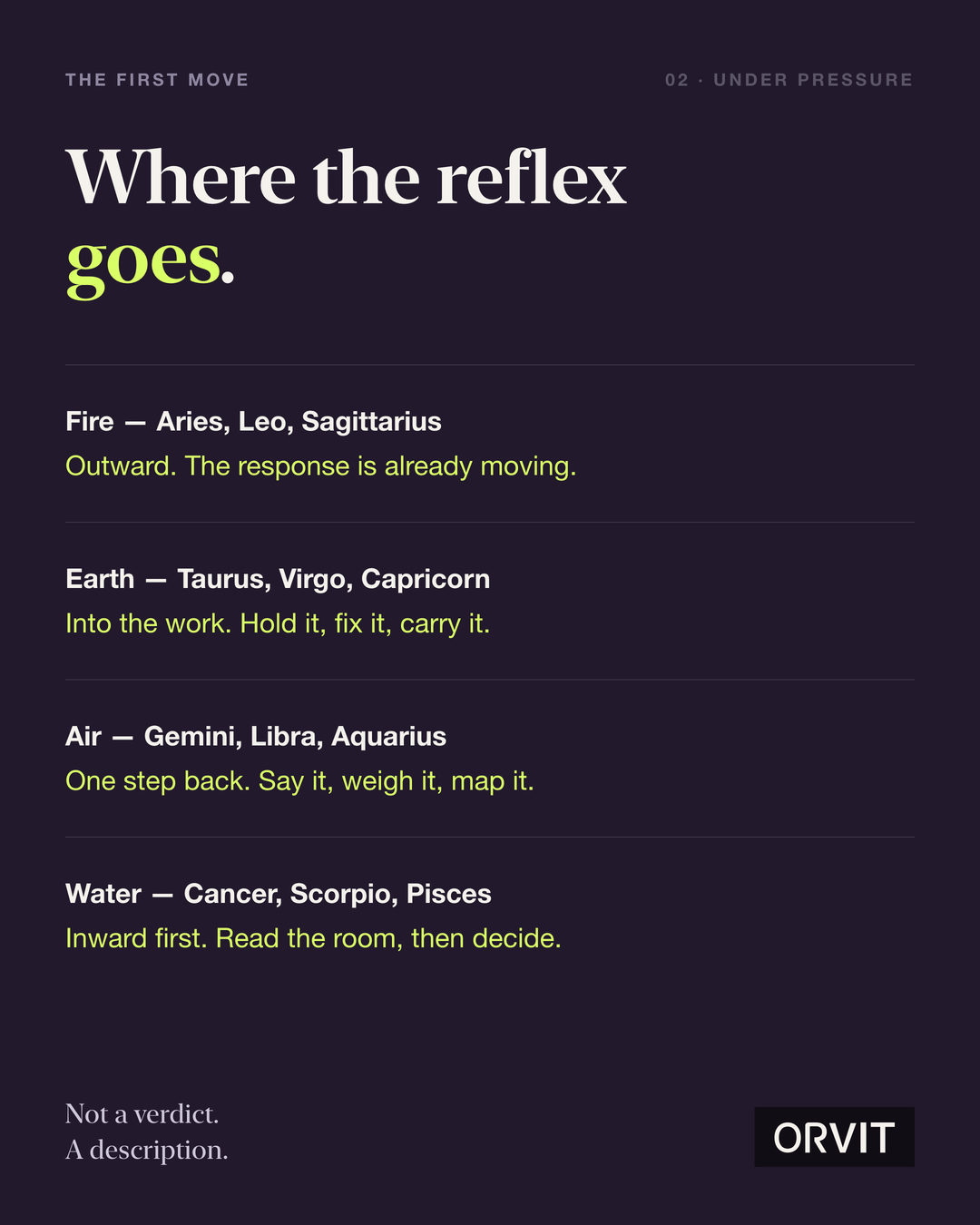
If one of these reads as unflattering, it is being read as a verdict and it is not one. "Goes quiet and inward" is not secretive, and "reacts in the moment" is not reckless. These are descriptions of where the first move goes, and every one of them is useful somewhere and expensive somewhere else.
What a Moon sign will not tell you
- What you are good at. Skill is not in a birth chart. A placement describes a tendency under load, not a ceiling.
- Whether you will get on with someone. Two people with the same Moon are comfortable and reach for the same response at the same time — comfortable is not covered.
- What you should do. The right column is what tends to help, not an instruction. If it does not match you, it does not match you — say so and write down what actually does.
How this connects to the rest
ORVIT is an astrology app built for work rather than dating, and the Moon is half of a Founder Type in it; the Rising sign is the other half, and it governs how you open rather than how you react. The two together resolve to one of 144 types.
And the right-hand column above is the raw material for the five axes in the work styles that clash. Those axes are where two people's needs collide; this is where each person's need comes from.
Questions people ask
How do I find my Moon sign?
You need your birth date, and your birth time only if you were born on a day the Moon changed sign. The Moon moves about every two and a half days, so a date alone settles it most of the time. Any birth-chart calculator will give it, ORVIT included.
What is the difference between my Sun sign and my Moon sign?
The Sun is closest to the version of yourself you would describe out loud. The Moon is the reflex — what you do first when a deadline lands or a conversation turns. At work the second one is the one that shows.
Does my Moon sign say what I am good at?
No. It describes where you go under pressure and what you need to keep working, not what you can do. Skill is not in a birth chart.
Can two people with the same Moon sign work together?
Yes, and they will be comfortable — and they will reach for the same response at the same time. Comfortable is not the same as covered.
The short version
Your Sun sign is the version you would describe; your Moon sign is the one that shows up on a deadline, which is why work cares about the second one. A birth date settles it unless you were born on a changeover day. The placement describes where your first move goes and what keeps it from taking the whole day — not your skill, not your ceiling, and not whether you will get on with anyone.
Find your Moon and Rising — 144 Founder Types, no account needed.