Cofounders
30 Questions to Ask a Potential Cofounder
In an earlier post we listed seven things to check before you commit to a cofounder. This is the other half: the actual questions. Thirty of them, grouped by the same seven areas, each with a note on why it earns its place.
You are not running an interview. You are trying to find out how two people will behave when the work gets hard, and you are trying to find out now, while the answer is still cheap. The questions below are written to be asked out loud, in a normal conversation, by someone who wants this to work.
How to use this list
Do not ask all thirty in one sitting. Thirty questions in a row is an interrogation, and people perform under interrogation rather than tell you the truth. Spread them across the natural stages of getting to know someone.
Working style and pace
- Walk me through your last two weeks of work. What did an actual day look like?People describe the version of themselves they intend to be. A calendar describes the one they are. Ask for the concrete version first.
- Do you ship at 70% and fix, or hold until it's right?This is the single most common source of daily friction, and neither answer is wrong on its own — only unmatched.
- When you're stuck, how long before you ask for help?Predicts whether problems reach you early, while they are small, or late, when they are expensive.
- Which hours are genuinely yours, and which are off-limits?Availability mismatches are almost always discovered at the worst possible moment. Find the boundary before you need it.
- What's the last thing you shipped that you were embarrassed by?Tests two things at once: tolerance for imperfection, and willingness to be honest about their own work.
Decisions and deadlock
- When we disagree and we both feel strongly, who decides?The most important question on this list. Unresolved decision rights are where most cofounder conflict actually begins.
- Which decisions do you want to own outright?Clear domain ownership removes the need to break most ties in the first place.
- Tell me about a decision you got wrong. What did you do next?The recovery pattern tells you more than the mistake. Look for what they changed, not how sorry they were.
- Do you want consensus, speed, or data?These are three different companies. Better to learn which one you are each imagining now.
Communication
- How do you prefer to hear bad news?Everyone has a preference and almost nobody is asked. Getting this right buys you years of easier conversations.
- When something bothers you, how long before you say it?The gap between "immediately" and "when it's unbearable" is the difference between friction and a blow-up.
- How much do you want to know about what I'm doing day to day?Prevents both of the classic failures: feeling surveilled, and feeling abandoned.
- What does too much communication look like to you?Asking for the upper bound surfaces expectations that "how often should we sync?" never reaches.
Conflict
- Describe the worst professional conflict you've had. What was your part in it?The second sentence is the question. An account with no personal contribution at all is the answer.
- When we disagree hard, do you want to push through or step away first?One of you wanting distance and the other wanting resolution, in the same argument, is its own second argument.
- How do you know when you're actually over something?Distinguishes people who repair from people who go quiet and keep score.
- Have you ended a working relationship before? What happened?How someone talks about a past partner is a preview of how they will one day talk about you.
Values and long-term vision
- What does success look like in five years — for the company and for you?Ask for both. People often have a company answer ready and have never said the personal one out loud.
- Would you sell for life-changing money in year three?A concrete number makes an abstract disagreement visible immediately.
- What would make you walk away from this?Everyone has a threshold. Knowing where it sits is more useful than pretending it doesn't exist.
- What's a line you wouldn't cross to win?You will eventually face a shortcut. Better to know now whether you would both refuse it.
- Whose opinion matters to you when you make a big call?There is usually a third person in the room — a partner, a former boss, an investor. Meet them early.
Roles, equity, and money
- What equity split feels fair to you, and why?The reasoning matters more than the number. A number without reasoning cannot survive a change in circumstances.
- Are you comfortable with vesting and a cliff?Hesitation here is worth understanding. Vesting protects whoever stays, which may well be them.
- What happens to equity if one of us leaves in year one?The scenario nobody wants to picture is exactly the one the agreement exists for.
- What are you putting in besides time — money, network, IP?Unstated contributions become resentments. Say them out loud while they are still generous offers.
- How long can you go without income?Different runways pull a team apart quietly, long before anyone names the reason.
Commitment and risk
- Is this full-time? If not, when does it become full-time?"Soon" is not a date. Ask for the trigger and the month.
- What else are you committed to right now?Other projects, advisory roles, and contracts are fine. Discovering them in month four is not.
- What would have to happen for you to quit?Closes the loop with question 20 from the other direction, and it is the one people answer most honestly.
How to read the answers
There are no correct answers on this list, which is the part most people get wrong. You are not scoring a candidate. You are looking for two things: whether their pattern and yours can survive contact, and whether they can describe themselves accurately.
The second one matters more than it sounds. Someone who says "I get quiet when I'm frustrated, and it takes me a day" has given you something you can plan around. Someone who says "I'm easy to work with" has given you nothing — not because they are lying, but because they have not looked.
Watch for the gap between the answer and the behaviour. Someone can sincerely believe they ship fast and still hold every decision for a week. That is why the working-style questions belong in a trial project rather than a coffee shop — you get to compare the two.
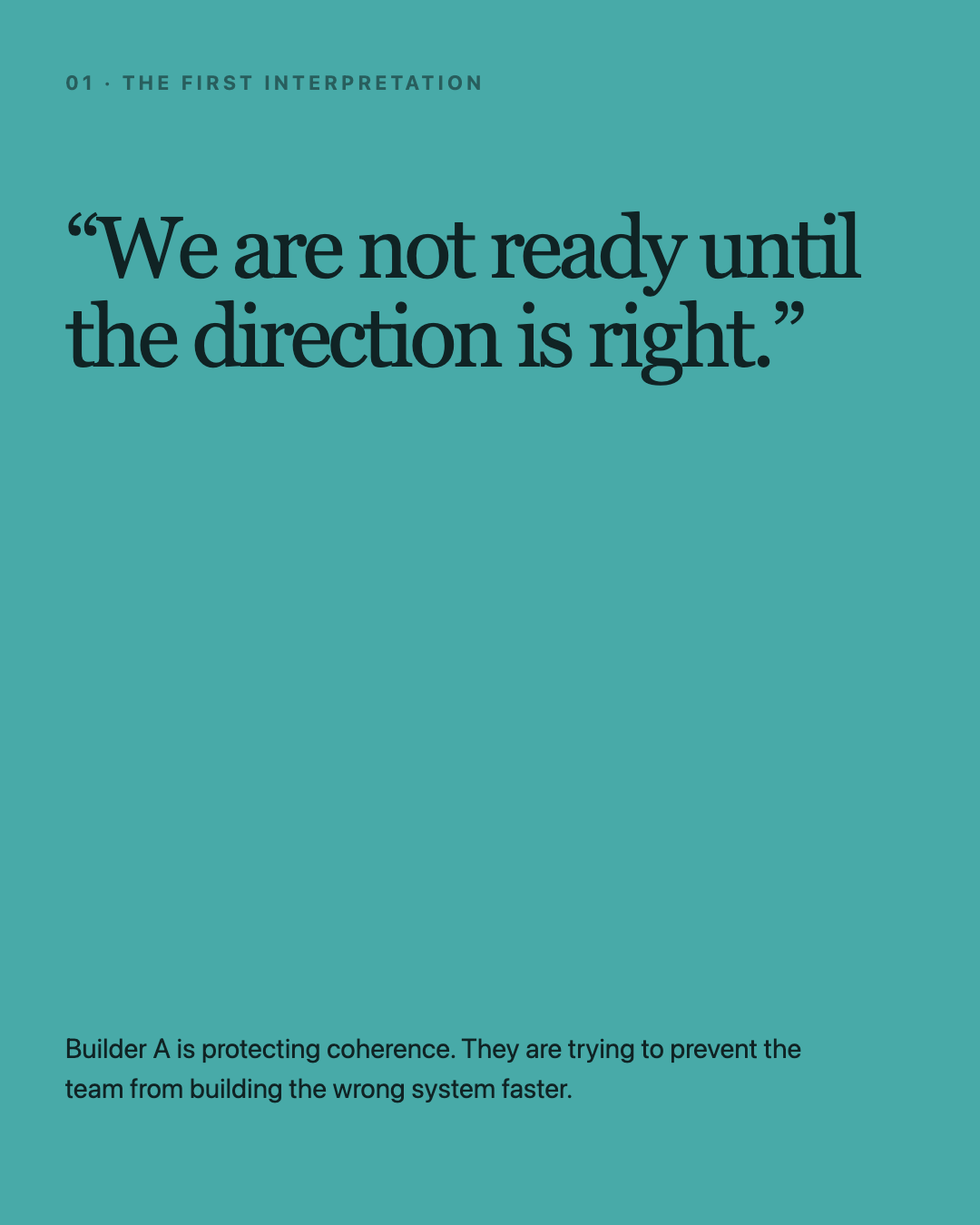
And remember that the same sentence can have two honest readings. "We're not ready until the direction is right" can be someone protecting the team from building the wrong thing quickly, or someone avoiding a decision. The words are identical. The pattern underneath is not, and only time or a trial project will tell you which one you are hearing.
What not to ask
A founding conversation is not a job interview, but the boundaries are similar and worth respecting. Avoid age, marital and family status, plans to have children, health and disability, religion, ethnicity, and sexual orientation. None of these predict how someone works. In many jurisdictions asking them in a hiring context is unlawful, and a cofounder conversation is not far enough away from that to be comfortable.
If what you actually want to know is whether someone will be available, ask about availability. If you want to know about financial runway, ask about runway. The legitimate question is almost always available in a direct form, and the direct form gets you a better answer anyway.
Where ORVIT fits
Questions work best when you already have some idea of what to listen for. ORVIT approaches this from the collaboration side rather than the dating side: your ORVIT Founder Type describes how you tend to communicate, decide, lead, and execute, and a Synergy Analysis looks at how you and a potential cofounder may work together across communication, execution, leadership, growth, and conflict. It will not tell you whether to commit. It will tell you which of these thirty questions to ask first. More in the FAQ.
New to the term? We wrote the full definition: what an ORVIT Founder Type is, how it is calculated, and what it cannot tell you.
Questions people ask about this
How many should I actually ask?
Not all thirty at once. Use the three stages above: a handful in the first conversation, the working-style and decision questions during a trial project, and the money and commitment questions before you sign anything.
Isn't it strange to ask a friend these?
It is stranger not to. Friendship tells you that you enjoy each other's company. It tells you very little about how you each behave under deadline pressure, financial stress, or disagreement. Founding with a friend raises the cost of getting it wrong, which is an argument for asking more carefully, not less.
What if they refuse to answer something?
A refusal is information, but it is not automatically a red flag. Some questions are genuinely private, and early on a person may reasonably decline. What matters is whether they say so plainly or deflect. "I'd rather discuss that once we're further along" is a fine answer. Changing the subject three times is a pattern.
Before or after we start working together?
Both. Ask the values and commitment questions before you invest real time, because those rarely change. Ask the working-style questions during a short trial project, because what people say about their own pace and what they actually do can differ — and a trial shows you the difference.
The short version
- Ask in three stages, not one sitting
- Working style and values first — they decide whether to continue
- Decisions, communication, and conflict during a trial project
- Money and commitment before anything is signed
- Look for accurate self-description, not correct answers
- Compare the answer to the behaviour
- Keep the questions to the work, and ask the direct form
None of this guarantees a good partnership. It does mean that the things which usually surface in month eight will surface in week two instead, while they are still a conversation rather than a breakup.
Know what to listen for
See your ORVIT Founder Type and explore how you and a potential cofounder may work together.
Get ORVIT