Founder Types
Founder Type vs MBTI for Teams
Somebody on your team has already asked everyone for their four letters. It is the fastest way to get a room talking about how people work, and that is a real thing to be good at. The question is what you do with the answers — and whether they can carry the weight of a hiring decision, a cofounder decision, or a reorg.
The short answer is that they cannot, and the people who publish the test say so themselves. This is a look at what MBTI actually measures, where it comes apart when you point it at a team, and what an ORVIT Founder Type measures instead — including the part where our own approach has a bigger problem than theirs.
What does MBTI actually measure?
The Myers-Briggs Type Indicator asks you a series of forced-choice questions and sorts your answers along four dichotomies — where you direct attention, how you take in information, how you decide, and how you handle the outside world. The four results combine into one of sixteen four-letter types.
It was built by Katharine Cook Briggs and Isabel Briggs Myers from Carl Jung's writing on psychological types, and it was built for a specific purpose: to help a person recognise their own preferences and find work that suited them. That purpose is worth holding onto, because almost every problem below comes from using the instrument for something it was not designed to do.
In one line: MBTI is a self-description sorted into sixteen boxes. It is a good vocabulary for a conversation and a poor input for a decision about somebody else.
Where does MBTI break down on a team?
Five things go wrong, and they compound.
The input is self-report. Every answer is the person describing themselves. That is fine when someone is exploring their own preferences in private. It is a different situation when a candidate, a new hire, or a cofounder you are courting fills it in — all of them have an obvious reason to answer as the version of themselves they would like to be. Nobody has to lie for this to distort the result.
The four letters are cut points, not categories. The traits underneath are continuous. Two people sitting one point either side of a line get different letters and read as different types, even though they are nearly identical. Two people at opposite ends of the same letter get the same letter and read as the same. The type hides the distance that actually matters.
Retaking it can change the result. A meaningful share of people receive a different four-letter type when they take the questionnaire again some weeks later. That is a poor foundation for a seating chart, let alone a partnership.
The publisher says not to use it for selection — including for teams. This is the part that surprises people. The Myers & Briggs Foundation's ethical guidance states that it is not ethical to use the MBTI for hiring or job assignments, and that the assessment is not intended for the selection of job candidates, for internal decisions about job placement, or for selections for teams or task forces. That last clause is the one that matters here. If you are sorting people into teams by four letters, you are working against the instrument's own publisher.
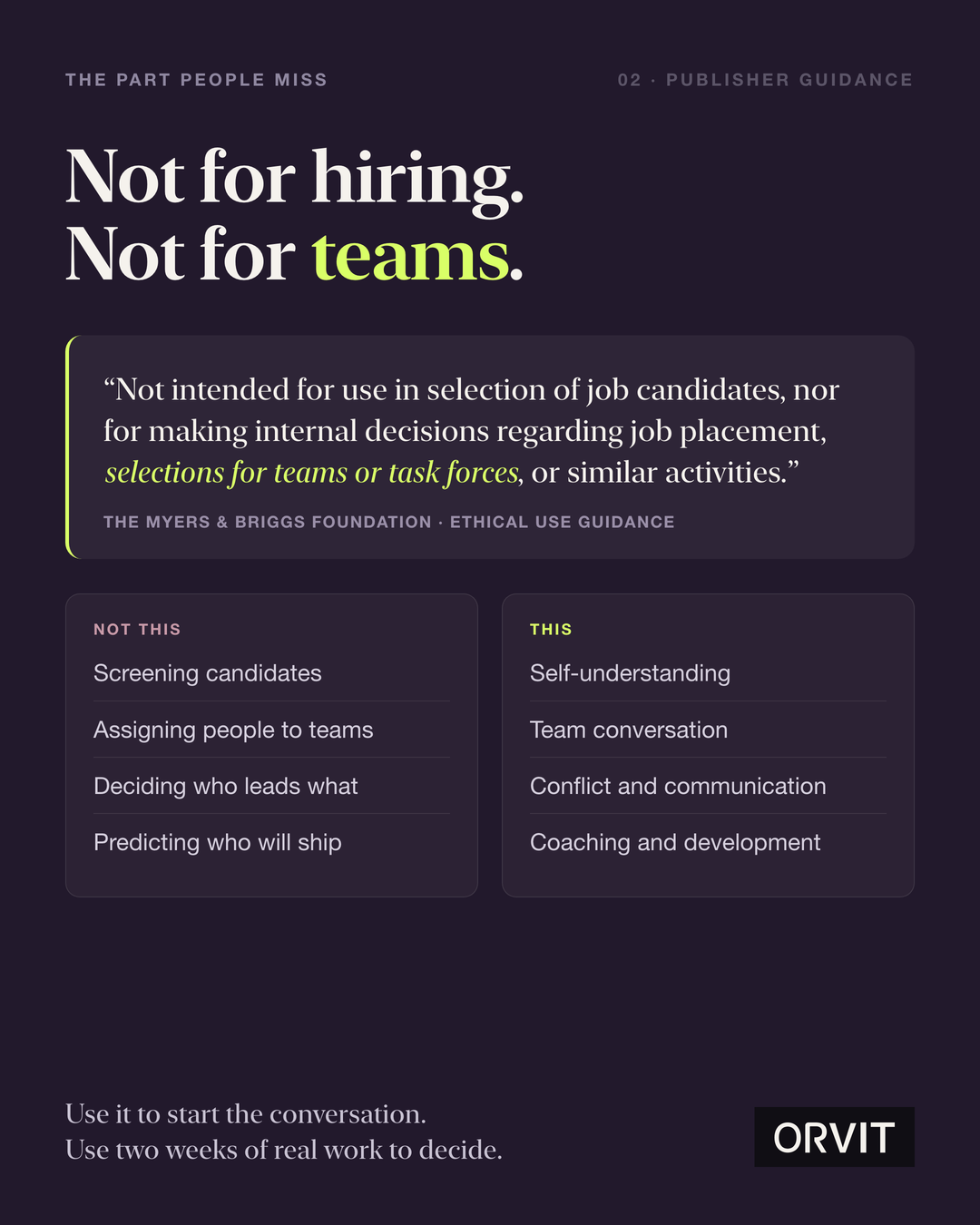
Type-to-type pairing has no established evidence. There is no accepted body of research showing that particular four-letter combinations work better together than others. The pairing charts that circulate online are folk wisdom with a chart on top.
So why does everyone still use it?
Because it works as a language, and teams are starved for one.
Most teams reach for a personality test because they want a language for team compatibility that does not sound like an accusation. Most work friction is not caused by people being bad at their jobs. It is caused by two reasonable people running on different defaults — one needs to think before speaking and the other thinks by speaking, one wants the decision closed and the other wants it open one more day. Teams rarely have permission to talk about that directly. A personality framework gives them permission.
That is genuinely valuable, and it survives every criticism above. The framework does not have to be a measurement to be a useful excuse to have the conversation. The failure is not in using it. The failure is in forgetting that is what you are doing.
What does a Founder Type measure instead?
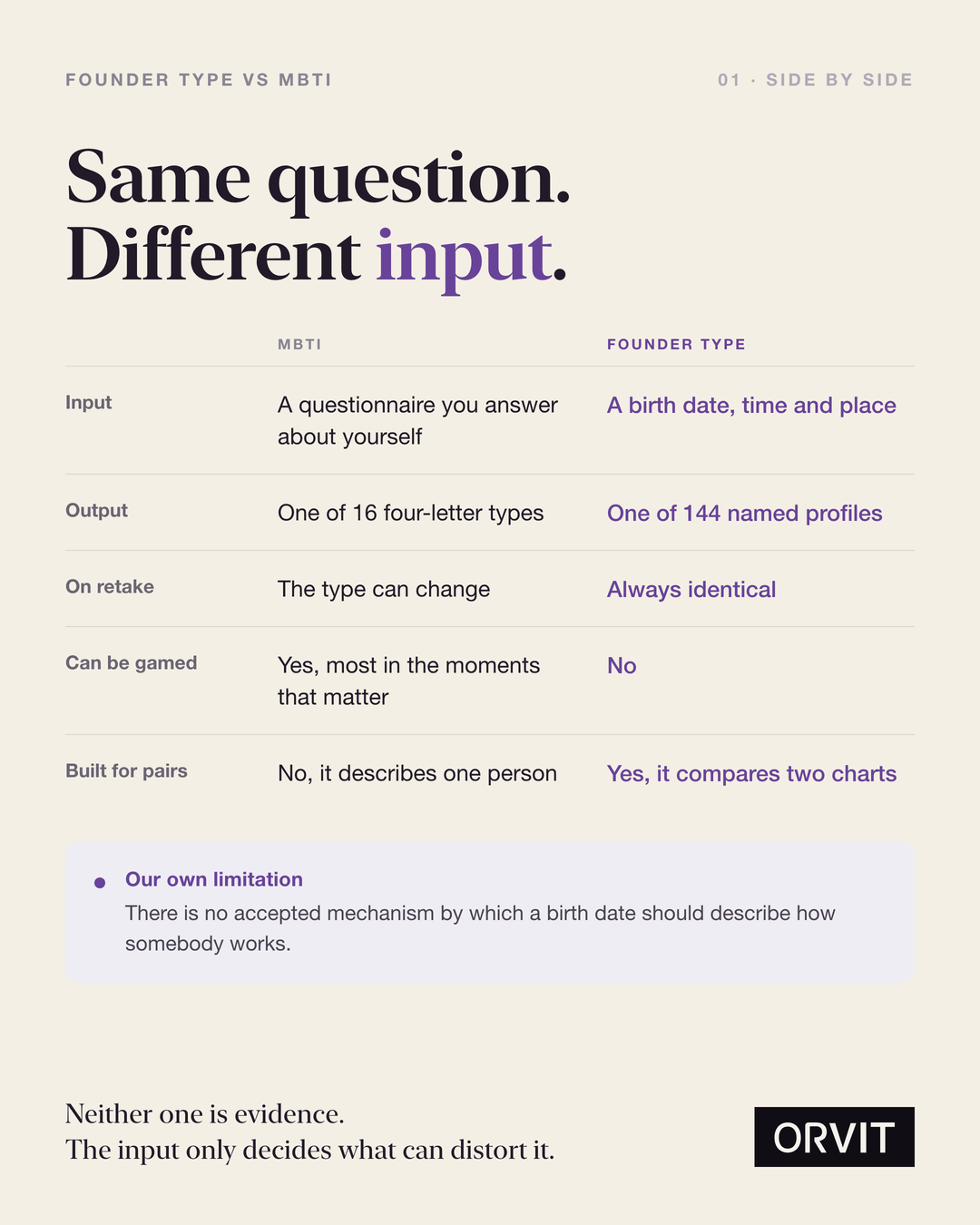
An ORVIT Founder Type is built from two points in a birth chart — the Rising sign and the Moon sign — which produce a named work-style profile out of 144. Rising describes the outward half: how you open, set pace, and show up in a room. Moon describes the inward half: what you need under pressure and what quietly drains you.
There is no questionnaire. You supply a birth date, and ideally a time and place, and the work style profile is derived. It is identical every time you generate it, and nobody can shade it toward the answer they want.
How does a Founder Type compare with MBTI?
That last row is the important one, and we would rather write it ourselves than have you find it in a comment thread. Removing self-report bias is a real advantage. It is not a small advantage. But we bought it with a much larger objection, and anyone who tells you a birth chart is validated for team formation is selling something.
Should either one decide who gets hired?
Both of these are prompts. Neither is evidence, and neither is a team compatibility score you can defend to the person it was used against.
If a profile tells you that one of you closes decisions fast and the other needs a night to sit with them, the value is not in the claim being true. The value is that the two of you now have a concrete thing to check against last month — did that actually happen, and did it cost us anything? Sometimes the answer is no, and the profile was wrong, and you have learned more from disagreeing with it than you would have from a result that flattered you both.
Using either one to decide who gets the offer skips all of that, and it converts a conversation starter into a filter that nothing has earned the right to be.
How do you actually compare two people?
Run a small piece of real work and watch the seams.
- Pick something that finishes in two weeks and has a deadline neither of you controls. Vague collaborations hide everything this exercise is meant to surface.
- Write down who decides what before you start, in one line each. The disagreement about where that line sits is more informative than any profile.
- Look at a profile after, not before. Read it as a list of hypotheses about the two weeks you just had. Mark the ones that matched and the ones that did not.
- Have the conversation the mismatches point at. That is the entire return on the exercise.
If you want the longer version of this, we wrote it up in 30 questions to ask a potential cofounder and the cofounder compatibility checklist.
Questions people ask
Can MBTI predict whether two cofounders will work well together?
No. It was designed to describe individual preference, not to score a pair, and its publisher's guidelines say it should not be used for selection. There is no established research showing that particular pairings outperform others. It remains useful as shared vocabulary.
Is a Founder Type more accurate than MBTI?
No, and we do not claim that. It removes self-report bias and replaces it with a larger objection. Both are conversation tools.
Why does the input matter so much?
Because the input decides what the result can be distorted by. A questionnaire can be answered strategically by someone who wants the job. A birth date cannot be shaded. That does not make the output true — it makes it stable.
Should we run a personality test before choosing a cofounder?
Run a small real project instead. What happens when the two of you ship something under a deadline is worth more than any profile.
The short version
MBTI is a good vocabulary and a bad filter, and the company that sells it agrees with the second half. A Founder Type trades self-report bias for a bigger unproven assumption and is honest about it. Use either one to start the conversation. Use two weeks of real work to make the decision.
See all 144 Founder Types — no account needed.