Deciding
Red Flags Before You Commit
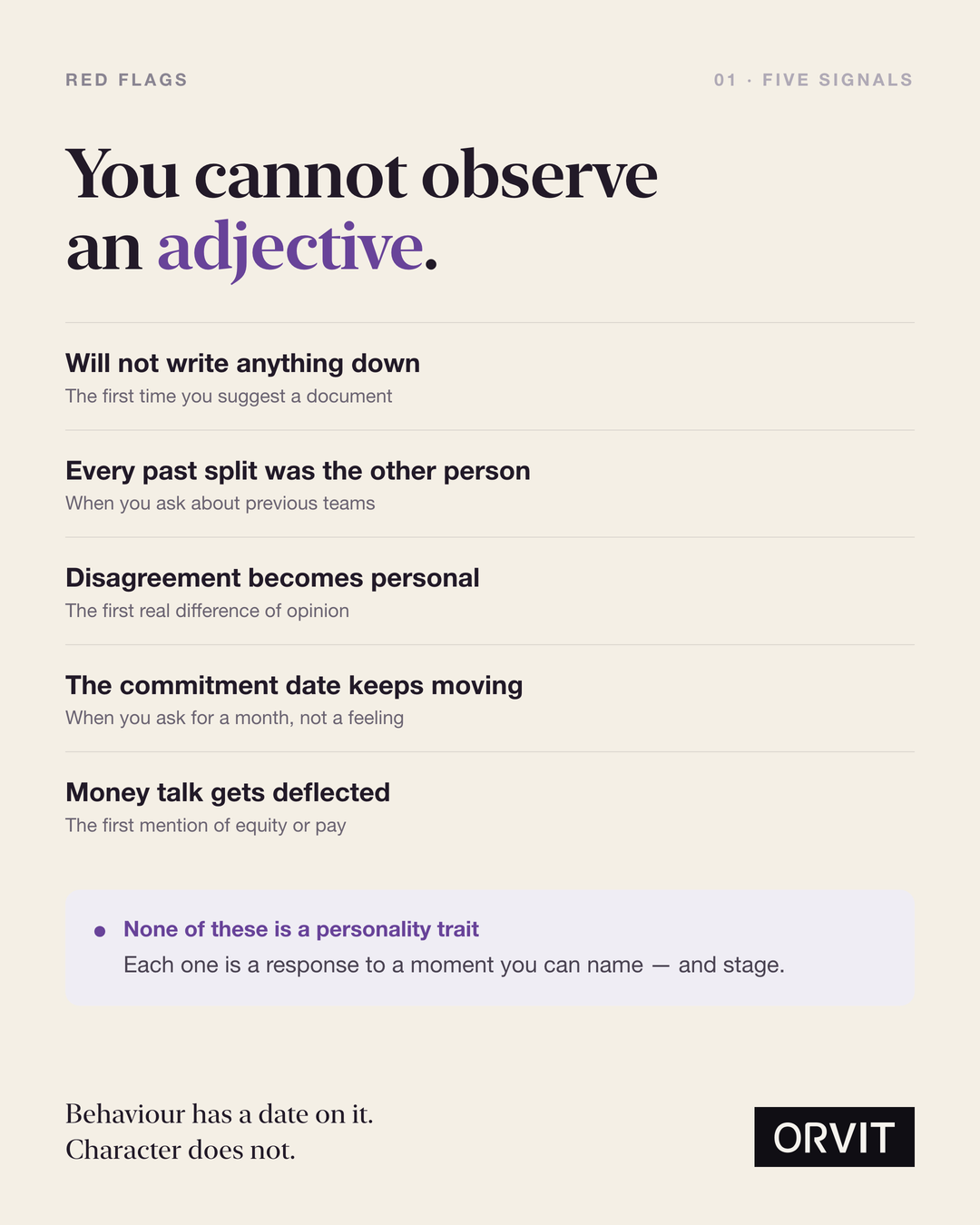
Most lists of cofounder red flags are lists of adjectives. Arrogant. Flaky. Controlling. They are satisfying to read and nearly useless to act on, because you cannot observe an adjective — you can only observe behaviour, and the behaviour that matters does not show up over coffee. It shows up the first time something is at stake.
This is the piece the seven signs of cofounder conflict left open. That one is about a partnership you are already in. This one is about the stage before: what to watch for while you can still walk away cheaply, and how to make the signals appear instead of waiting for them.
Does a bad team really kill a startup?
You have seen the number: 65% of startups fail because of cofounder conflict. It comes from Noam Wasserman's research at Harvard Business School, and it is quoted almost everywhere with that wording.
The wording is wrong in two ways worth knowing. First, his category is "people problems" — which includes founder-employee tension, not only conflict between founders. Second, the retellings disagree about the sample: some say 10,000 founders, others 6,000 startups. A number that changes shape as it travels is a number to hold loosely.
For contrast, CB Insights' analysis of 400+ startup post-mortems puts "not the right team" at 23%, behind no market need. Both things are true at once: team is reliably a top-three killer, and it is not the majority cause.
In one line: the honest version is less dramatic and more useful — team problems will not usually be why you fail, and they are the failure you have the most control over before it starts.
Why character is a weak predictor
Because almost everyone presents well in the courtship phase, and because the traits people screen for are the ones least connected to outcomes. Confidence reads as arrogance in one person and vision in another. Caution reads as rigour or as dithering depending on whether the decision turned out well.
There is a second problem, which is that a trait is unfalsifiable early. If you decide someone is "controlling," every subsequent thing they do becomes evidence. You are no longer observing — you are confirming. Behaviour under a specific, dated, consequential condition does not bend that way.
The five signals that actually show up
These are not personality flaws. Each one is a response to a moment you can identify, and each one appears before the money does.
Note what is missing: nothing about how they present, how senior they sound, or whether people like them. Those are the things a first meeting is good at measuring, which is exactly why they are not on this list.
Do not wait for the signals. Stage them.
Every signal above needs a trigger, and if you wait for the trigger to arrive naturally you will be six months in and holding equity. You can create all five in about three weeks.
- Do real work with a real deadline. A short paid project with a written scope. Not an idea session — something that ships and can be late. Three weeks of this shows you more than six months of coffee, because there is finally something to be wrong about.
- Put one small thing in writing. Not the cap table. A one-page scope for the trial itself. The reaction to that page is the whole test: someone who improves it is different from someone who finds it insulting.
- Ask for a date, not a feeling. "Which month do you go full time?" If the answer is conditional, ask what the condition is and write that down too. A condition you can name is a plan; one you cannot is a maybe.
- Disagree on purpose, once, about something real. Pick a decision where you genuinely differ and take it to the end. You are not testing whether they concede. You are watching whether the disagreement stays about the decision.
- Say the money sentence early. "Before we go further I want to talk about how we would split this." You do not need to settle it — that conversation has its own shape. You need to see whether the subject is allowed to start.
If you have not done the earlier groundwork, it is in the cofounder compatibility checklist and 30 questions to ask a potential cofounder.
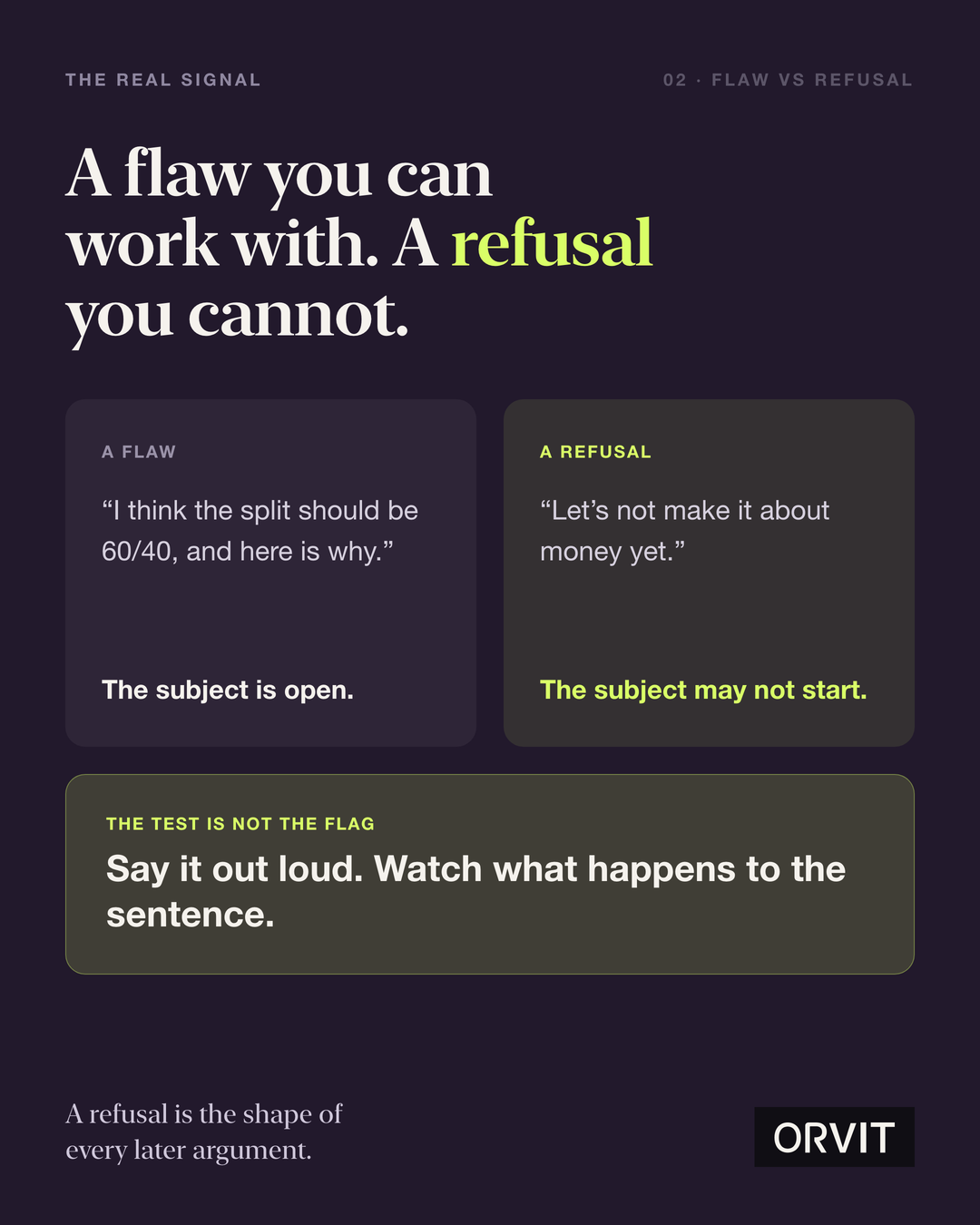
The strongest signal is not a flaw. It is a refusal.
Look back at the five. Underneath each one is the same thing: a subject that is not allowed to exist. Not disagreement about the terms, not a different answer than you wanted — a refusal to let the conversation happen at all.
That distinction is the most useful one in this piece. Flaws are workable; you will have several yourself. A refusal is different, because it tells you the shape of every future argument. The person who will not put a three-week scope in writing is telling you what will happen when the stakes are a company.
And the honest test is not the flag itself but the response to naming it. Say the sentence: "When you said we do not need to write it down, that worried me." Someone who engages with that is someone you can build with, flaws included. Someone who makes you regret having said it has answered a different and more important question.
Where a founder profile fits, and where it does not
Not here, mostly. ORVIT Founder Types describe tendencies — how someone is inclined to decide, share, and commit. A tendency is not a warning, and we do not publish a risk score, because a profile cannot see the thing this article is about: what a specific person does when a specific subject is raised.
What a profile is genuinely good for at this stage is narrower. It gives you the agenda — the five or six places where two people are most likely to diverge — so the trial project has something to look for. Reading a description and saying "that is wrong about me, here is what actually happens" is a better opening than a blank page. That is the whole offer, and stretching it further would be selling you a prediction we could not defend.
One limit worth stating. The five signals here come from watching founding teams come apart, not from a validated instrument. They are the ones that keep recurring. Use them as things to look at, not as a screen that produces a verdict.
Questions people ask
Is one red flag enough to walk away?
Usually not. Any one of these appears in people who go on to build something good. What matters is the response when you name it: someone who hears "this worries me" and engages is different from someone who makes you regret saying it.
What if we are already friends?
Then you have more information about how they behave and less about how they work. Friendship tells you about loyalty under ordinary conditions. It says almost nothing about how someone handles being wrong in front of a customer, and working styles clash on axes friendship never touches.
Can I test for this without being insulting?
Yes, and the test is not a test — it is doing real work together with real stakes. A short paid project with a deadline and a written scope shows you more in three weeks than six months of coffee. Framed as "let's try one thing together first," almost nobody is offended. The ones who are have told you something.
What is the single strongest signal?
A refusal. Not a flaw, a refusal — to write something down, to name a date, to discuss money, to be disagreed with. Flaws are workable. Refusals are the shape of every later argument.
The short version
The number everyone quotes is softer than it sounds, and it does not change what to do. Screen for behaviour, not character: whether they will write one page down, how they describe the people they left, whether a disagreement stays about the decision, whether a date holds, whether money is allowed to come up. Do not wait for those moments — build a three-week project that creates all five. Then say the uncomfortable sentence out loud and watch what happens to it. That response is the signal. Everything else is an adjective.
See how you and a potential cofounder work — 144 Founder Types, no account needed.