Team Chemistry
7 Signs of Cofounder Conflict
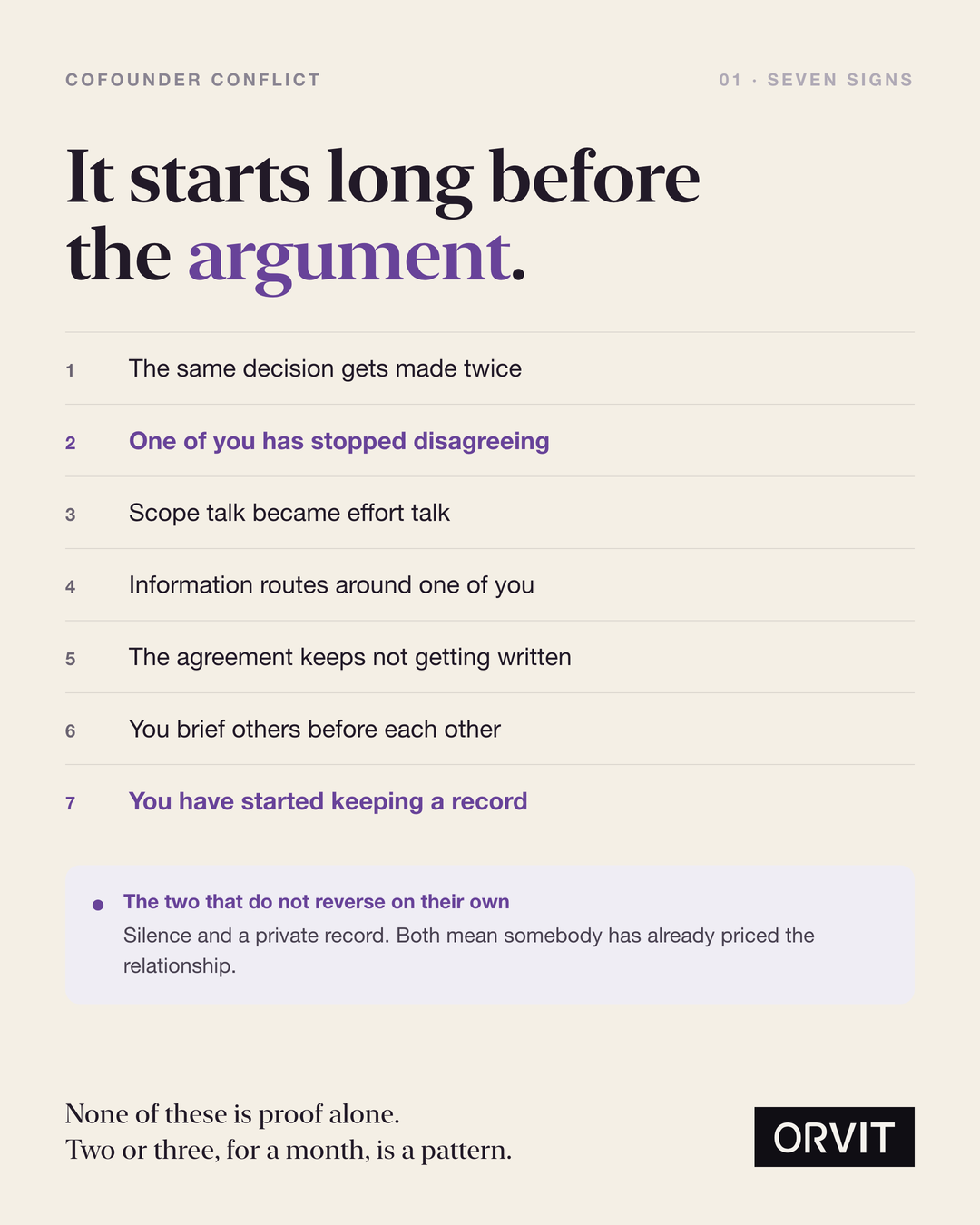
Almost nobody notices the first six months of a cofounder problem. There is no fight to point at. There is a decision that quietly gets made twice, a partner who has stopped pushing back, and a folder of screenshots that one of you started keeping without ever deciding to. By the time it looks like conflict, it has usually been running for a while.
Noam Wasserman, then at Harvard Business School, studied roughly ten thousand founders for The Founder's Dilemmas and found that 65% of high-potential startups that failed did so because of people problems rather than product, market, or funding ones. That number is worth sitting with. It means the thing most likely to end the company is the thing least likely to be on the agenda.
What follows is a list of what that looks like early, while it is still cheap to fix. None of these is proof of anything on its own. Two or three together, running for a month, is a pattern.
Why does conflict show up before the argument does?
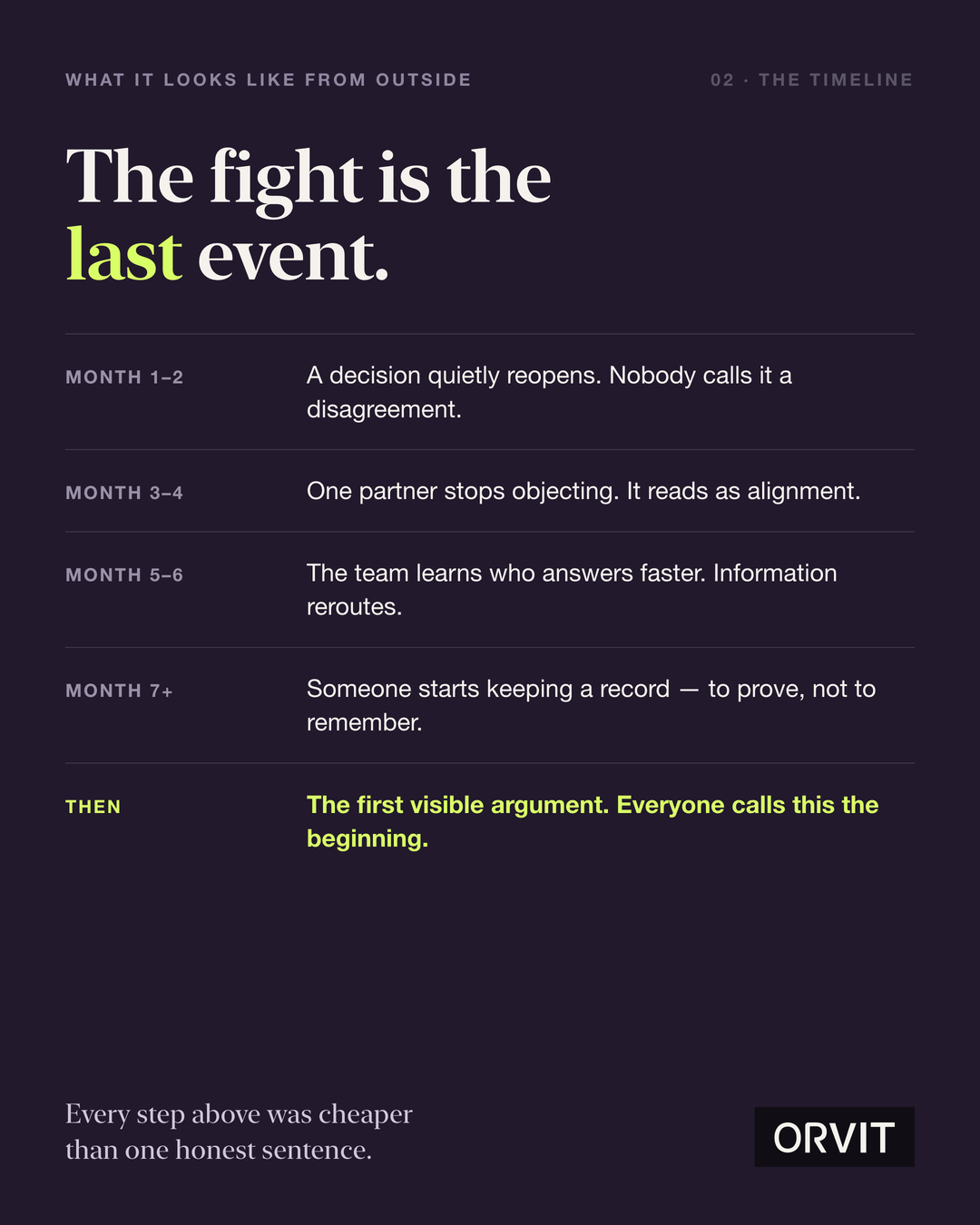
Because the argument is expensive and the workarounds are free. When two people disagree about something structural — who decides, what the company is, what a fair split looks like — the honest conversation costs an afternoon and some risk. Routing around each other costs nothing today and a little more every week after.
So the disagreement does not disappear. It converts into behaviour. Every sign below is a workaround that was cheaper than a sentence.
In one line: cofounder conflict is not the fight. The fight is what happens when the workarounds finally stop working.
What are the seven signs?
1. The same decision gets made twice. Something closes in a meeting and reopens in a message three days later, with a reason that is technically new. Nobody is being difficult. One of you never actually agreed, and the meeting ended before that surfaced — so the disagreement comes back in a form that does not require anyone to admit it is the same disagreement.
2. One of you has stopped disagreeing. This one gets read as alignment, which is why it survives so long. But a partner who used to push on three things a week and now pushes on none has rarely become convinced. More often they have done the arithmetic and concluded that objecting costs more than it returns. What they withhold first is the objection, not the work — which is exactly why it looks fine.
3. The conversation moved from scope to effort. You used to argue about what to build and how far it should go. Now you compare who did more. Scope is arguable — you can point at the thing and settle it. Effort is unmeasurable and unfalsifiable, so once it becomes the currency the argument has no exit and no winner.
4. Information starts routing around one of you. An engineer asks the other founder something that is clearly yours. A customer email lands in one inbox and stays there. Nobody planned this. The team has simply worked out which of you is faster to get an answer from, and traffic follows the cheaper path. It is the most objective sign on this list because other people are doing the measuring for you.
5. The agreement keeps not getting written. Equity, roles, vesting, and what happens if someone leaves stay verbal for another month, and another. The delay is almost never laziness. It is both of you avoiding a sentence you already suspect you disagree on, and a founder agreement is a document made entirely of those sentences.
6. You brief other people before you brief each other. An advisor, an investor, or a senior hire hears your read on the problem before your cofounder does. It feels like getting perspective. Functionally it is building an outside consensus to bring back as leverage, and the other person can usually feel the shape of it when it arrives.
7. You have started keeping a record. Screenshots. A private doc with dates. Forwarding a thread to your own inbox. The tell is not the record itself — it is the purpose. You are not writing it down to remember. You are writing it down to be able to prove. That is the point at which you have privately stopped expecting good faith, usually months before you would say so out loud.
Which signs can wait and which cannot?
They do not compound at the same speed. Two of them are load-bearing: they change what the other person expects from you, and expectations are much harder to walk back than decisions.
If you recognise the two marked fast, the useful move is not a better process. It is a conversation this week.
Does this mean the partnership is over?
No, and the assumption that it does is part of why these run so long. Every one of these signs is a symptom of a disagreement that has not been said out loud. Said out loud, most of them are ordinary and solvable — you wanted different things from the same decision, and neither of you noticed in the room.
What does not survive is the version where both of you can see the signs and neither names them. That is not a disagreement. That is an agreement to stop being honest, and it is the only failure on this list that gets worse with time no matter what else improves.
What do you do once you recognise two or three?
- Name the pattern, not the person. "We have reopened the pricing decision three times" is a fact you can both look at. "You keep relitigating things" is a claim about character, and it turns the conversation into a defence.
- Pick the oldest one. The most recent incident is rarely the real one. Ask what the first version of this was, and go there instead.
- Write the unwritten thing. If sign five is on your list, that is your afternoon. Not the whole agreement — just the one clause you have both been walking around.
- Give the quiet one something to decide. If your cofounder has stopped objecting, more space to speak will not fix it. A decision that is actually theirs will.
- Set a date to check. Four weeks. If the same two signs are still running, the problem is structural and the next conversation is about structure, not behaviour.
If you are earlier than this and still deciding whether to commit at all, we wrote the pre-commitment version separately: the cofounder compatibility checklist and 30 questions to ask a potential cofounder.
If what you recognise looks less like bad faith and more like the two of you simply operating differently, the mechanism underneath is in work styles that clash.
Can a compatibility profile predict any of this?
Not honestly, and we would rather say so than sell you the other answer. Nothing we build — including ORVIT Founder Types — detects conflict. A profile is generated from birth data, not from what happened in your last four standups, so it cannot know that a decision reopened or that somebody has gone quiet.
What a profile can do is narrower and still worth something: it gives two people a neutral third object to argue with. It is easier to say "this says I close decisions faster than you do — is that what has been happening?" than to open with the accusation. The value is in the question it makes askable, not in the claim being true.
One more honest limit: the seven signs above are observations from working with founding teams, not a validated instrument. Nobody has run a controlled study showing that four of these predict a split. Treat them as a checklist for a conversation, not a diagnosis.
Questions people ask
Is cofounder conflict always a bad sign?
No. Teams that disagree in the open tend to outlast teams that do not disagree at all. The risk indicator is not the volume of disagreement — it is disagreement disappearing without anything being resolved.
How early is too early to raise this?
There is no too early, and the cost curve runs the other way. The same conversation costs an afternoon in month three and a lawyer in year three. What makes it hard is that in month three you have no incident to point at, which is exactly why a list of signs is useful.
What if only one of us thinks there is a problem?
That is itself sign two, viewed from the other side. Bring one concrete instance rather than a general concern, and ask what they saw happen in that instance. Disagreement about the interpretation is workable. Disagreement about whether the event occurred is a different, larger problem.
Do these apply to a cofounder who is also a close friend?
More so, because the workarounds are cheaper. In Wasserman's data more than half of founding teams were friends or family, and teams formed from prior coworkers rather than friendships tended to stay intact longer. Friendship gives you more ways to avoid the conversation, not fewer.
The short version
Conflict does not start as a fight. It starts as a decision made twice, a partner who stopped objecting, and a record you began keeping without deciding to. Two of those — the silence and the record — do not reverse on their own. If you can see them, the fix is not a better process. It is one specific conversation, this week, about the oldest one on the list.
See how you and your cofounder work — 144 Founder Types, no account needed.