Cofounders
How to Split Cofounder Equity
Two people sit down, one of them says some version of "let's keep it simple and get back to work," and a number gets written down. It takes twenty minutes. It is the most valuable thing either of you will own, and it is being decided in the week you know the least about each other you will ever know.
Most of the time it holds. When it does not, the problem is rarely that the number was wrong. It is that nobody built a way to change it. This piece is about the conversation that has to happen before the number, and the one mechanism that makes the number survivable afterwards.
Why does this decision go wrong so often?
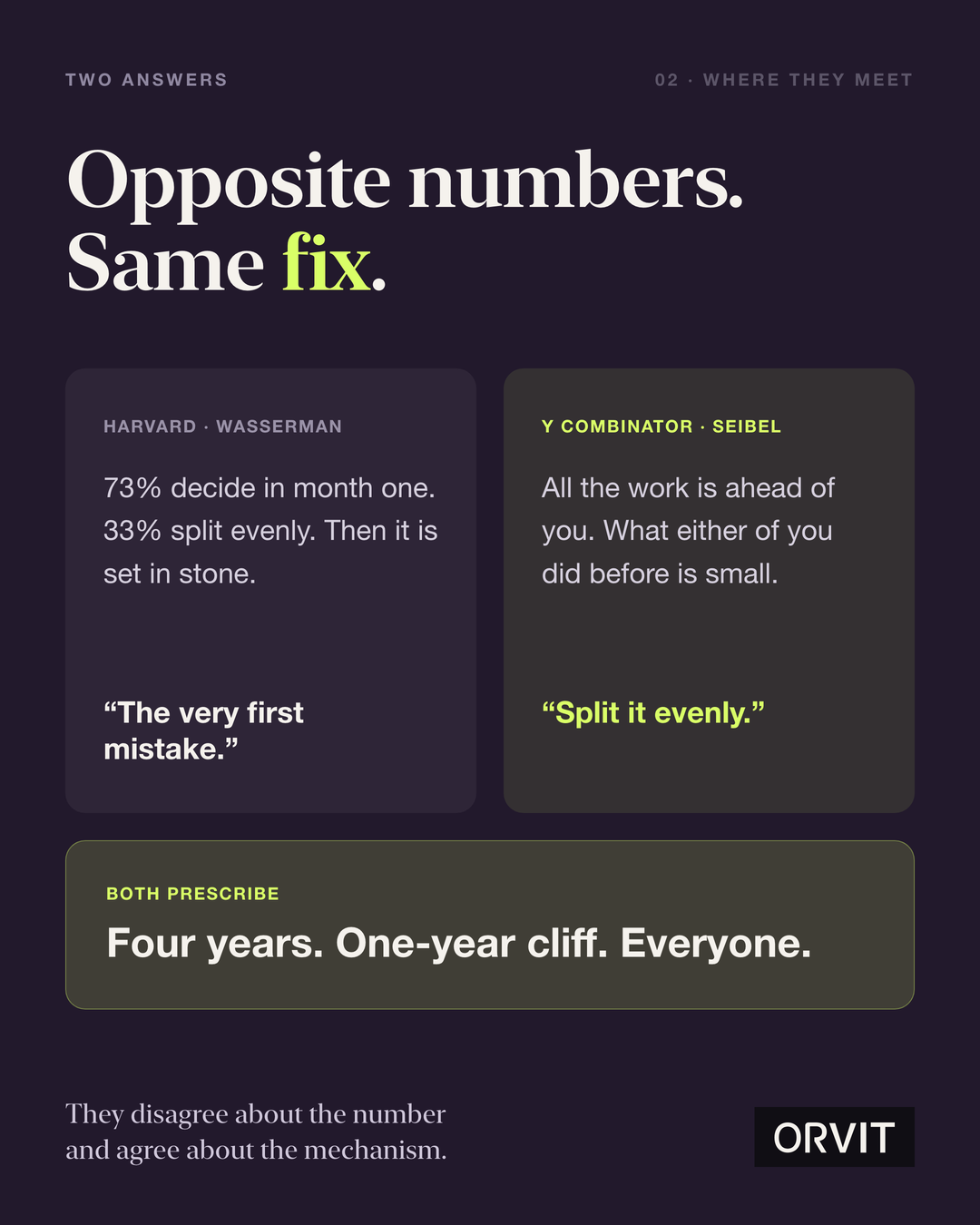
Because of when it gets made. Noam Wasserman, who studied thousands of founding teams at Harvard Business School, found that 73% of teams decide the split in the venture's first month, and most of them finalise it there. 33% split it evenly. He and Thomas Hellmann called the result the very first mistake most startup founders make — not because the number is usually wrong on the day, but because it is set in stone on the day you have the least information you will ever have.
Month one is before you know who answers messages at midnight and who disappears for a week. Before you know whose parents will fund six months of runway. Before either of you has been asked to do the part of the work you are bad at. You are pricing four years of behaviour from a sample of two weeks.
So is 50/50 wrong?
Not according to Y Combinator, which is a serious counterweight. Michael Seibel has written that near-equal splits are what YC almost always recommends, for a simple reason: at the point you are dividing, all the work is ahead of you. Whatever either of you did before is small against what is coming. His sharpest line is the one worth sitting with — if you are not willing to give your partner an equal share, perhaps you are choosing the wrong partner.
So the two most credible sources on this question reach opposite conclusions about the number. That is worth noticing, because it tells you the number is not where the answer lives.
Look at what they actually prescribe and the disagreement mostly dissolves. Wasserman's remedy is not "split it unevenly." It is to impose vesting on yourselves, so the split stays connected to what actually happens. Seibel recommends the same four-year schedule alongside the equal split. They disagree about the opening number and agree completely about the mechanism.
In one line: the split is a prediction. Vesting is what lets the prediction be wrong without destroying the company.
What are you actually dividing?
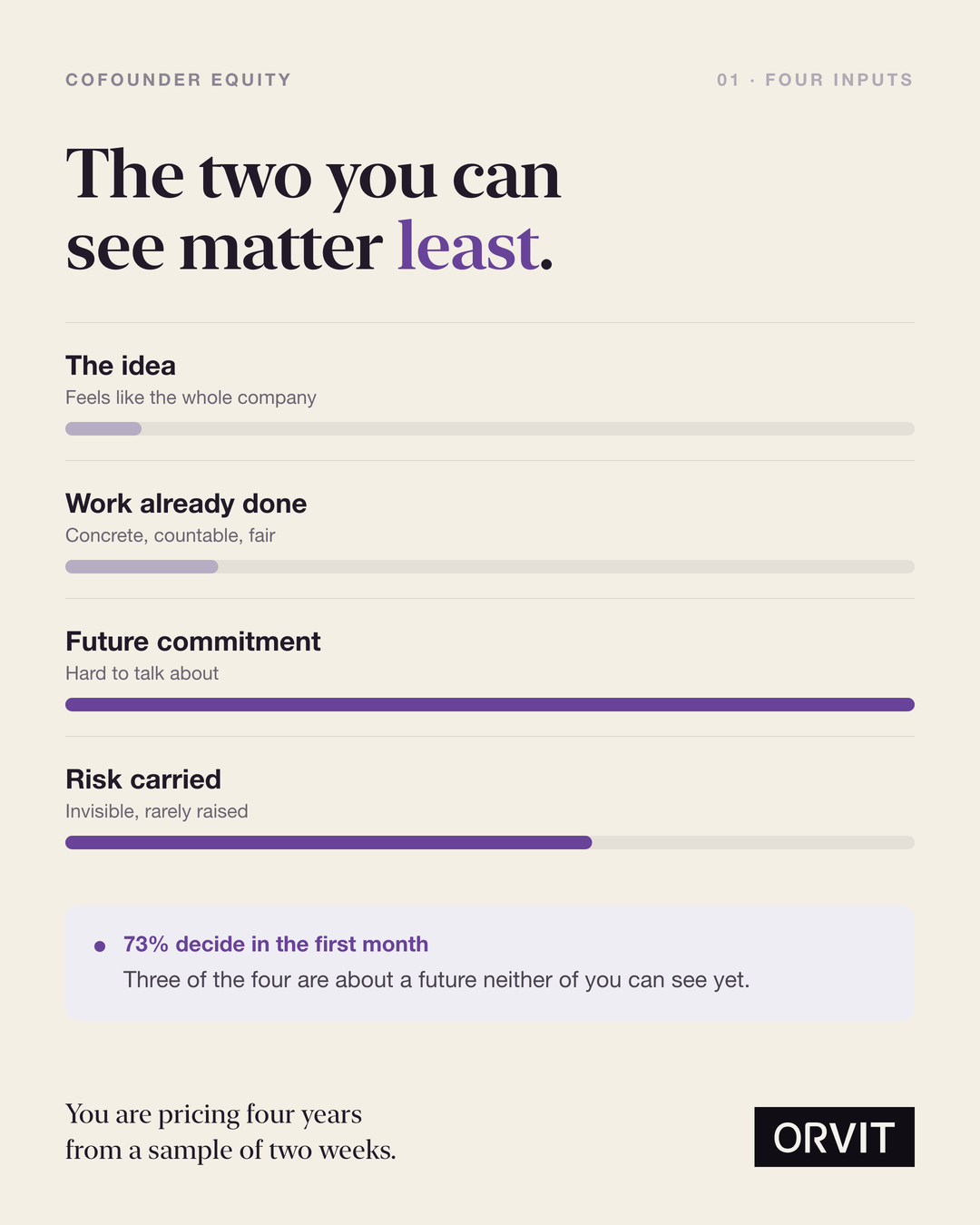
Four things, and they are not worth what people instinctively think they are worth.
Three of those four are about the future. That is the whole difficulty in one sentence: the largest inputs are the ones you cannot observe yet, and the two you can observe — the idea and the work already done — are the two that matter least.
The conversation that has to happen before the number
An hour, before anyone says a percentage. If this conversation is uncomfortable, that is the finding, not an obstacle to the finding.
- Each of you says what full time means, with a date. Not "soon" and not "once we raise." A month. Most equity resentment is a commitment disagreement that was never spoken in calendar terms.
- Price the things that are not equal. Salary given up, money put in, who has a partner covering rent and who does not. Put numbers on them. They belong in the split or in a loan, and either is fine — what is not fine is leaving them unnamed and letting them turn into a grievance.
- Say what would make you feel cheated in two years. This is the question that finds the real disagreement, because people answer it honestly. "If I am the only one still here on weekends." "If you leave after a year with a quarter of the company."
- Decide the number, then decide the review. Name a moment — the first financing, month twelve, the first full-time hire — when you both look at it again on purpose. A scheduled review is the difference between adjusting and renegotiating.
- Write it down the same day. Not for the lawyer, for you. Two memories of the same conversation drift apart within weeks, and both of you will be certain.
If you have not had the earlier conversations yet, they are the cofounder compatibility checklist and 30 questions to ask a potential cofounder. Equity is a bad place to discover that you never agreed on what the company is for.
The one mechanism both camps agree on
Vesting. The standard is four years with a one-year cliff: leave inside the first year and you keep nothing, reach the cliff and 25% vests, then it accrues monthly. It is the closest thing to a settled convention in this whole subject, and it is what Harvard and Y Combinator independently arrive at from opposite directions.
It applies to everyone, including the founder who is certain they will never leave — especially that founder, because the whole point is that the certainty is unverifiable on the day it is offered. Vesting is not a statement of distrust. It converts the split from a permanent guess into a claim that has to keep being earned, which is what both of you assumed you were agreeing to anyway.
The practical test: if one of you left in month seven, would the cap table still be something an investor could look at? If the answer is no, you do not have an equity problem yet. You have a vesting problem, and it is cheap to fix now and expensive to fix later.
Where a founder profile fits, and where it does not
Not on the number. Nothing about a personality profile, ours included, can tell you what percentage anyone should hold, and any product that claims otherwise is selling you something it cannot deliver.
What tendencies are genuinely useful for here is narrower and worth one sentence: they predict which of the four inputs each of you will over-weight. The founder who leads with vision tends to price the idea high. The founder who builds tends to price work already done high. The one who left a salary tends to price risk high and often does not say so out loud. Knowing that in advance turns a fight about fairness into a conversation about which column you are each standing in. ORVIT Founder Types are built for that conversation and nothing beyond it — we do not publish a compatibility score, because we could not defend one to the person it was used against.
Not legal or tax advice. Equity, vesting and founder agreements have real legal and tax consequences that differ by country and by structure. Use this to prepare the conversation, then take the outcome to a lawyer before you sign anything.
Questions people ask
Should the person who had the idea get more?
Usually not much. Execution is the scarce part, and the idea will not survive contact with customers unchanged. If the idea arrived with something transferable — a patent, revenue, a customer list — that is an asset. Price it as an asset, not as an idea premium.
What if one of us is full time and the other is not?
That is the largest real asymmetry, and it deserves a real answer. You have two options: different percentages, or the same percentage with different vesting start dates. The second is usually better, because it stops being a difference the day the part-timer goes full time.
Does 50/50 create deadlock?
It can, but that is a governance question wearing an equity costume. Equal ownership does not oblige you to decide everything together. Name who breaks the tie per domain, and write it down — the same per-axis logic that settles clashing working styles. Fixing it by moving to 51/49 buys a tiebreaker and costs you a partner who feels junior.
Can we just decide later?
You can delay, but not indefinitely — the moment you take outside money, hire, or file, it has to exist. And undecided is not neutral. It quietly favours whoever is more comfortable with ambiguity, and that person is not always the one who ends up carrying the company.
The short version
Three quarters of founding teams set the number in month one, when they know least, and then treat it as permanent. Harvard calls that the first mistake; Y Combinator says split it evenly anyway. Both prescribe the same fix, which tells you the fix is not the number. Have the commitment conversation before the percentage conversation, price the things that are genuinely unequal instead of leaving them silent, put everyone on four years with a cliff, and schedule the moment you will look at it again. The split is a prediction about people you have known for a month. Build it so being wrong is survivable.
See how you and your cofounder work — 144 Founder Types, no account needed.