Team Chemistry
Work Styles That Clash
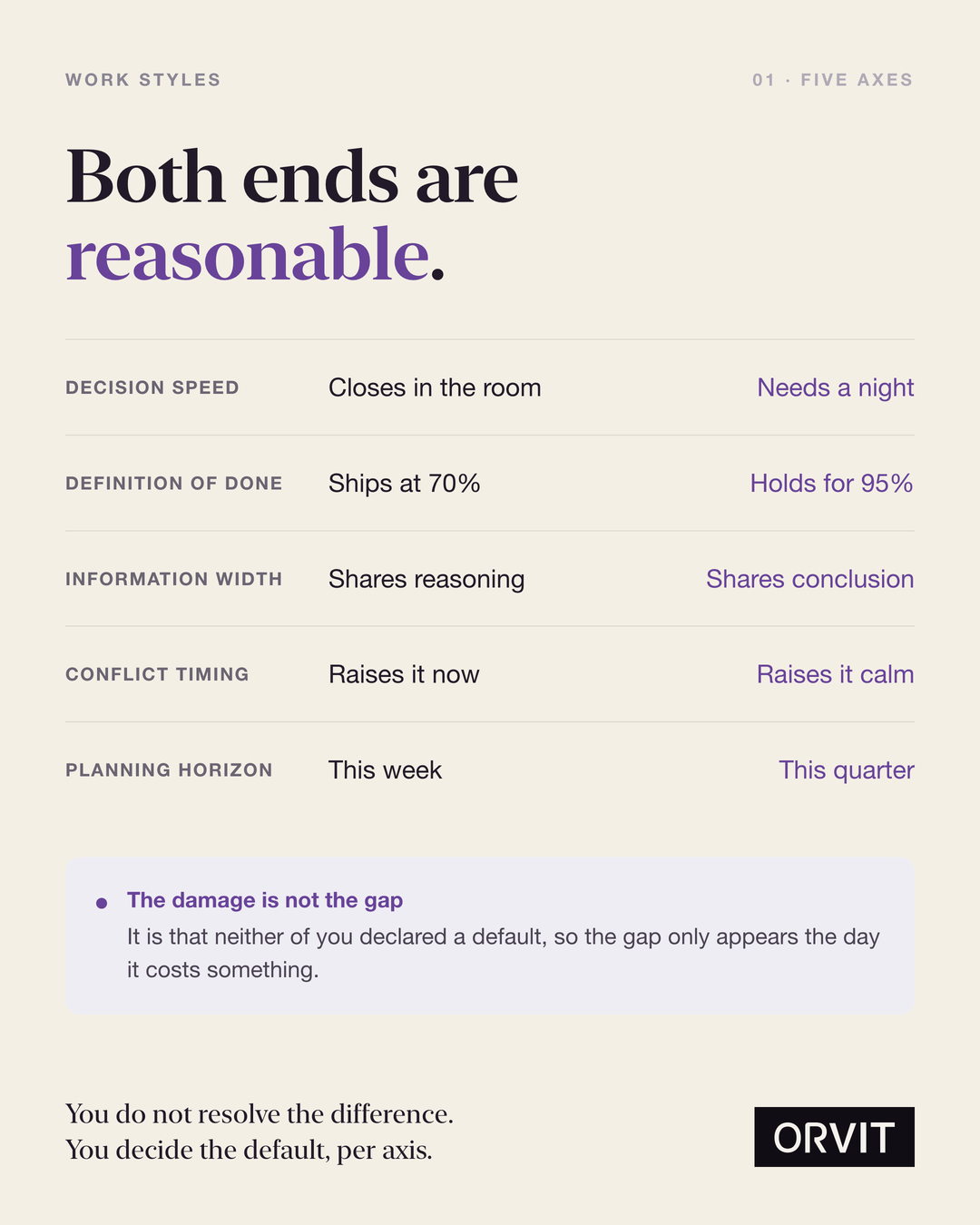
Two founders who work identically are not a team, they are a bottleneck with redundancy. The differences are the point. What causes damage is not that one of you closes decisions in an hour and the other needs a night — it is that neither of you has ever said so, so the difference only appears on the day it costs something.
This is the companion to the seven signs of cofounder conflict. That piece is about what you can already see. This one is about the machinery underneath: which differences actually generate friction, why they stay invisible until pressure arrives, and what to decide in advance so they stop being surprises.
Is a difference in working style actually a problem?
On its own, no. A difference becomes a problem at the moment it turns into an unspoken default — when one of you starts assuming a shared standard that was never agreed on, and reads every deviation from it as carelessness or obstruction.
The tell is in the language. "He is slow" is a difference converted into a defect. Stated properly it is: he requires a night to commit and I commit in the room, and we never decided which one this decision needs. The first version has no fix. The second has an obvious one.
In one line: style differences do not cause conflict. Undeclared defaults do.
Which differences actually clash?
Not the ones people usually test for. Introversion, morning versus night, neat versus messy — these are visible early and almost never load-bearing. The five below are invisible early and structural.
Look at the right-hand column. Every one of those moments is high-stakes, and none of them is where you want to discover the difference for the first time.
Why do these stay invisible until pressure arrives?
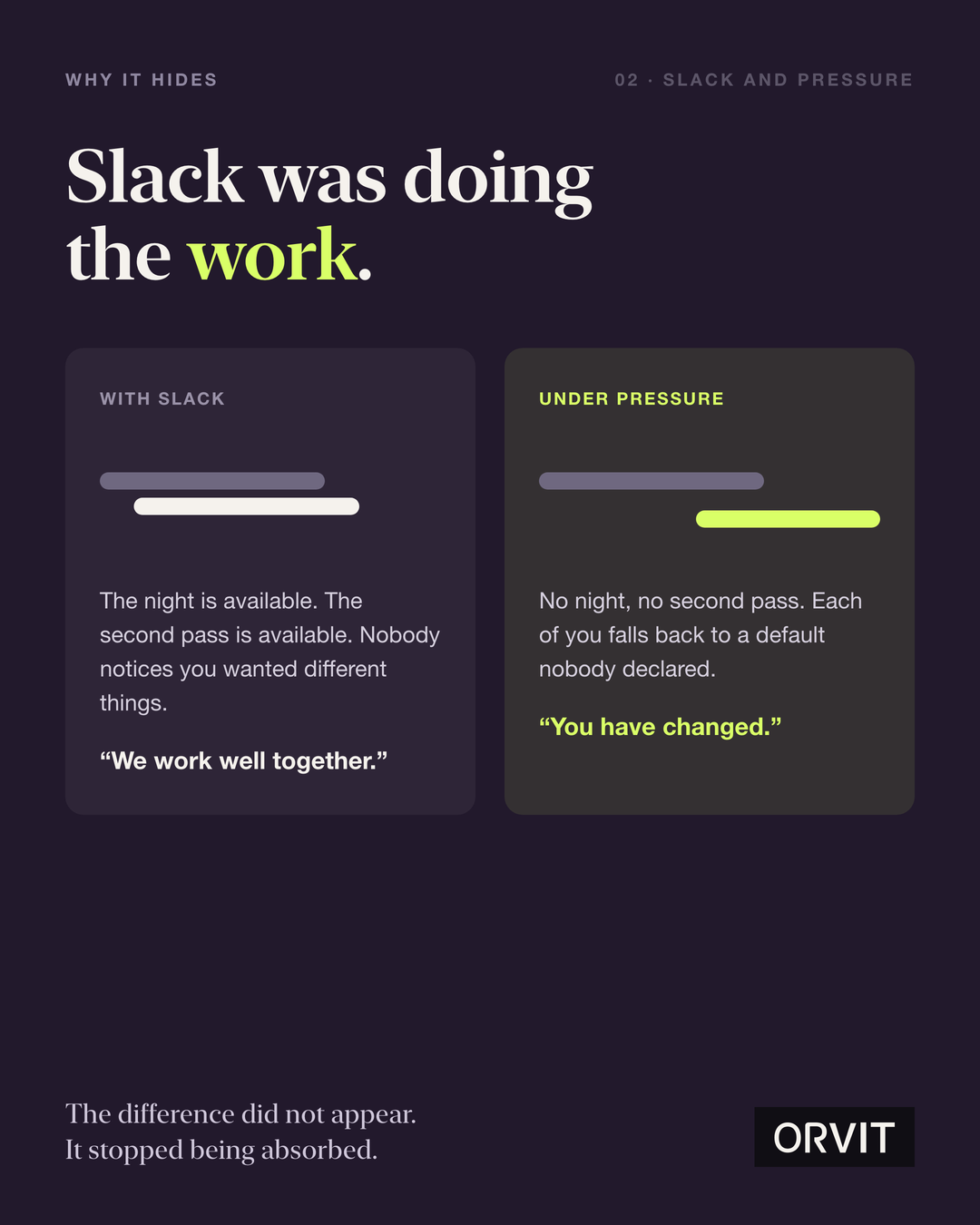
Because slack absorbs them. When there is time, the person who needs a night gets a night, the person who ships at 70% has room for a second pass, and nobody notices they wanted different things. Both of you conclude that you work well together — and that conclusion is real, it is just conditional on a condition nobody named.
Pressure removes the slack. Now the night is not available, the second pass is not available, and each of you falls back to your default. Both defaults are reasonable. They are simply incompatible in the same afternoon, and the first time you find out is the afternoon it matters.
So what actually separates teams that survive this?
Not compatibility. Google's People Analytics team spent two years on this question in a study known as Project Aristotle, examining 180 teams and measuring 250 attributes — personality, demographics, tenure, even how often teammates socialised outside work. They were looking for the right mix of people.
They did not find one. The strongest predictor of an effective team was psychological safety: whether people felt able to raise a concern, admit a mistake, or disagree without it costing them. Their summary is the sentence worth keeping: who is on a team matters less than how the team works together.
Applied to two founders, that is a demotion for the question everybody asks first. Whether your styles match is a second-order question. Whether either of you can say "I need until tomorrow on this" without it being read as a lack of commitment is the first-order one.
How do you settle a difference before it costs anything?
You do not resolve the difference. You decide the default, in advance, per axis. It takes about an hour and it converts five future arguments into five sentences.
- Take the five axes above one at a time. Each of you says where you sit. Not where you should sit — where you actually do, on a bad week.
- For each one, name the default and the exception. "We ship at 70% unless a customer sees it first." "Decisions close in the room unless someone asks for the night, and asking is free."
- Write who breaks the tie. Per axis, not in general. Whoever owns the outcome owns the call, and it will not be the same person every time.
- Say what the other person's version costs you. This is the part people skip and the only part that builds the safety above. "When you hold for 95% I lose the week" is information. "You are a perfectionist" is a verdict.
- Revisit after the first deadline that hurt. That week is the only real data you will get, and it is worth more than the hour you just spent.
If you are still deciding whether to work together at all, the earlier-stage versions are the cofounder compatibility checklist and 30 questions to ask a potential cofounder.
Can a profile tell you whether two styles will fit?
No, and the honest version of this is worth more than the sales version. ORVIT Founder Types describe tendencies — how a person is inclined to decide, share, and commit. A tendency is not a prediction about a pair, and we do not publish a compatibility score, because we could not defend one to the person it was used against.
What a profile is good for here is narrow: it gives you the five axes as a starting draft instead of a blank page. Two people rarely arrive at "where do you sit on definition of done" on their own. Reading a description and saying "that is wrong about me, here is what actually happens" is a better start than either of you sitting with a blank page, and it is the entire value on offer.
One more limit: the five axes here come from watching founding teams argue, not from a validated instrument. They are the ones that keep showing up. That is a reason to use them as a conversation agenda and not as a diagnosis.
Questions people ask
Should cofounders have similar working styles?
Similarity reduces friction and also reduces coverage. Two founders who both ship at 70% will move fast and miss the same things. The goal is not similarity, it is knowing where the differences are before a deadline finds them for you.
What if we already had the argument?
Then you have better material than any exercise would produce. Take that specific incident and work out which of the five axes it was really about. Most arguments that felt like character were one of these five with no default set.
Which axis causes the most damage?
Information width, in our experience, because it is the only one that compounds silently. A mismatch on decision speed announces itself the same day. A mismatch on how much gets shared is only discovered when somebody is blindsided, and by then it has been running for months.
Does this apply to a team that is not two founders?
The axes do. The remedy scales differently — with more people the default has to be written down somewhere durable rather than agreed in a conversation, or it decays back to whatever the most senior person prefers.
The short version
Different working styles are not the problem, and matching them is not the goal. The damage comes from defaults nobody declared, which stay hidden while there is slack and surface on the day there is none. Decide the default per axis, write who breaks the tie, and say out loud what the other person's version costs you. Google spent two years looking for the right mix of people and concluded it mattered less than whether people could speak.
See how you and your cofounder work — 144 Founder Types, no account needed.