Founder Type
Which Founder Types Clash
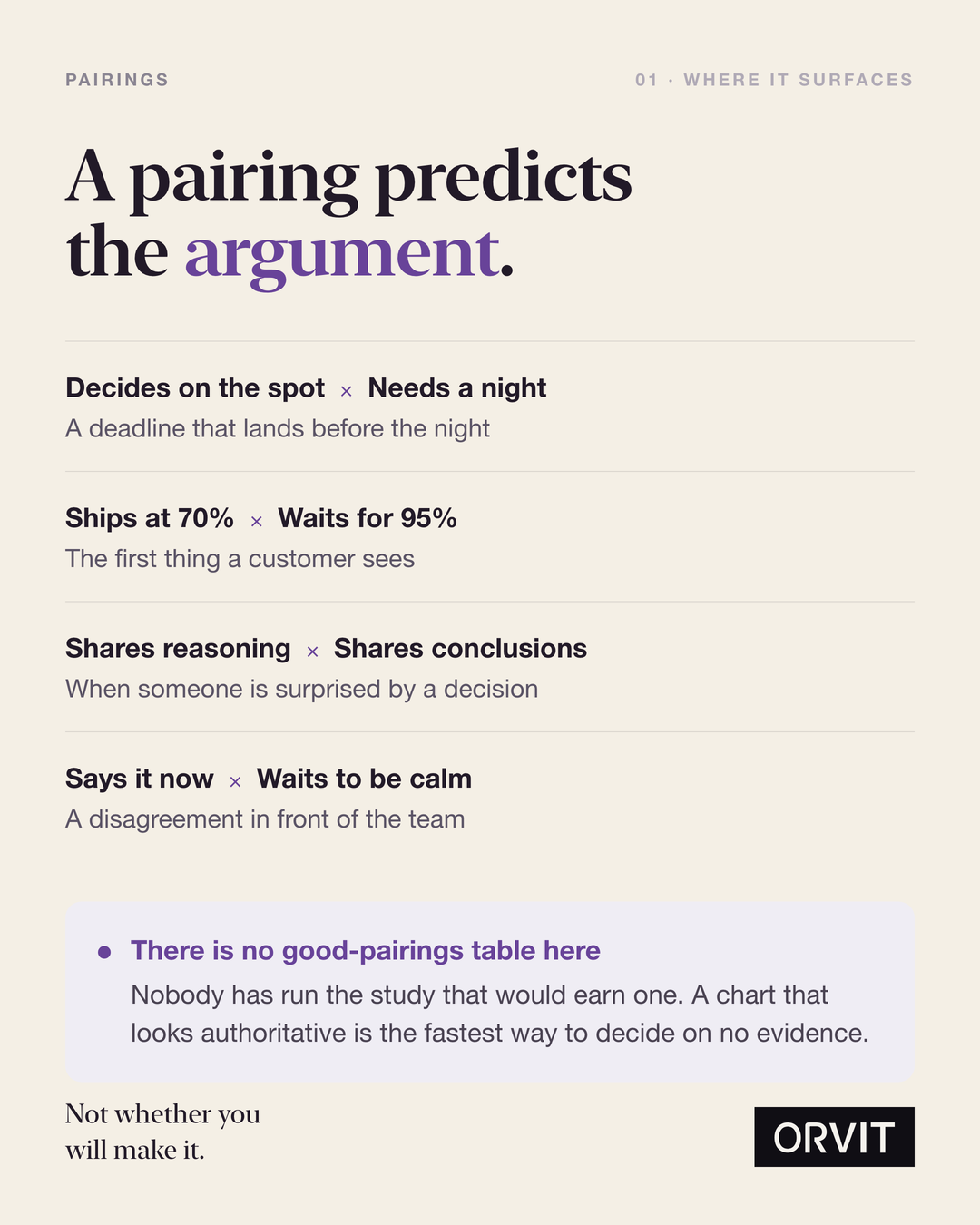
You probably came for a table: these two types work, those two do not. There is no such table here, and the reason is not modesty. Nobody has run the study that would earn the right to publish one, and a pairing chart that looks authoritative is the fastest way to make a real decision on no evidence.
What does recur, reliably, is friction — and friction is a different claim. We said in founder type vs MBTI that no profile predicts whether a pair will succeed. This piece is the honest half of that sentence: a pairing cannot tell you whether you will make it, but it can tell you, fairly well, where the argument will be.
Why there is no table of good matches
Because the thing a table would have to predict — two specific people building one specific company over four years — is not something a two-variable profile has ever been shown to forecast. The honest limit is not that the research disagrees with us. It is that the research does not exist.
There is a second reason, and it is the practical one. A good-match table gets used as a screen. Someone reads "these two clash" and declines a conversation with a person they would have built something with. The cost of that error is invisible and permanent — you never learn what you passed on.
In one line: a pairing predicts the location of the argument, not the outcome of the partnership.
What a pairing can actually tell you
Where two people sit on the five axes from working styles that clash. Those axes are not personality — they are defaults that only become visible under pressure, and a founder profile is a reasonable first draft of where someone sits.
When two people sit at opposite ends of the same axis, the same argument recurs. Not sometimes — reliably, and in a predictable place. That is a weaker claim than a compatibility score, and it is one we can actually stand behind.
The four pairings that keep producing the same argument
Read the middle column carefully, because it is the part that decides whether the pairing survives. Each of these gets narrated as a character flaw by whichever side is more frustrated, and the moment it becomes a character flaw it stops being fixable. "They are a perfectionist" has no remedy. "We never decided what done means for a first release" has an obvious one.
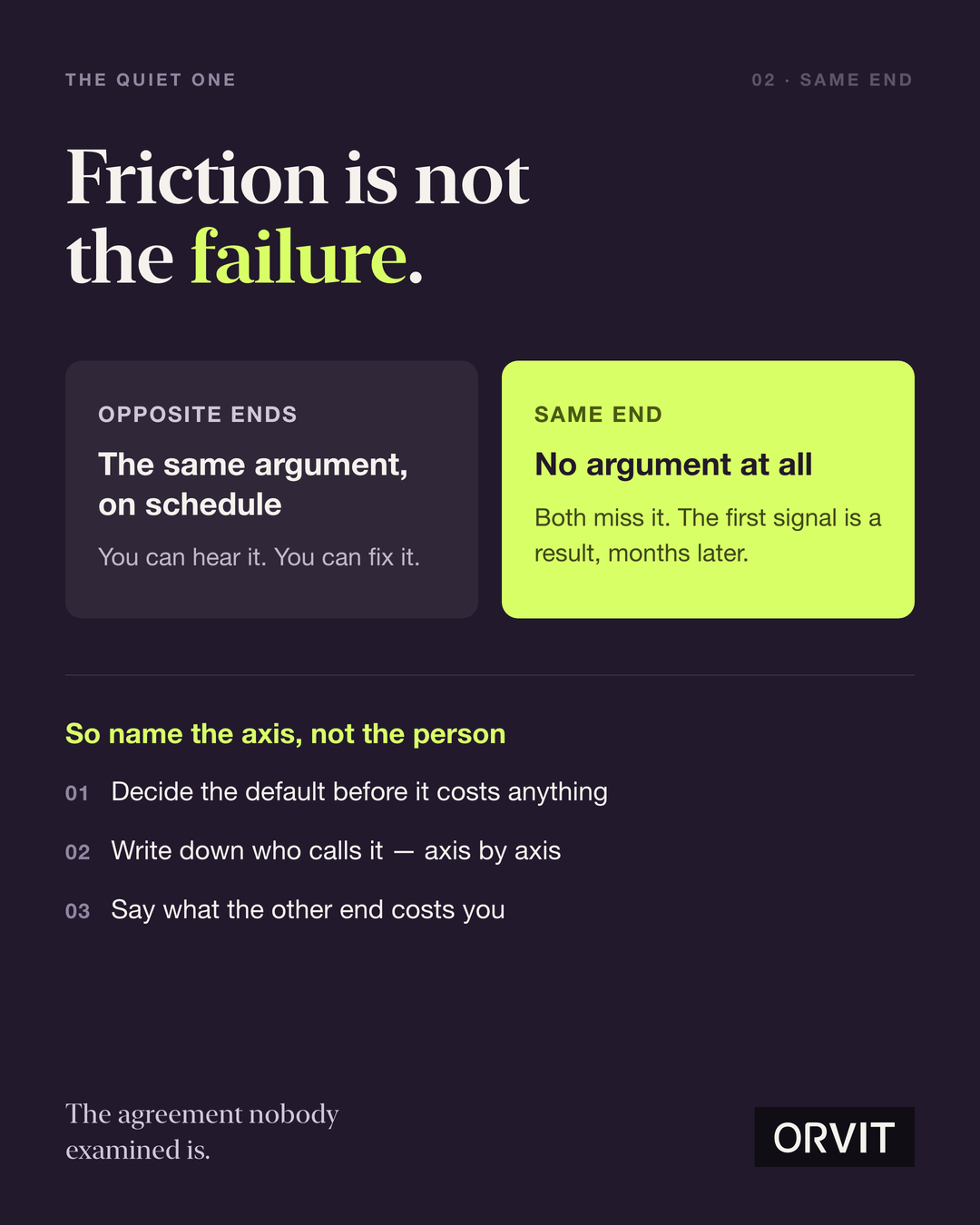
Two people at the same end clash too — just quietly
The assumption behind every compatibility table is that similarity is safe. It is not safe; it is quiet, which is a different thing and sometimes worse.
Two founders who both close decisions in the room will move fast and will both be surprised by the same missed consideration. Two who both hold for 95% will miss the window together and agree, sincerely, that the delay was necessary. Nobody in the room is positioned to see the gap, and there is no friction to warn you — the first signal arrives as a result, months later.
Friction is not the failure mode. An unexamined agreement is.
What to do with the pairing you have
Not change it. You cannot pick a cofounder by axis position and you should not try. What you can do is take the axis the friction sits on and settle it before it costs anything.
- Name the axis, not the person. "We sit at opposite ends on definition of done" is workable. "You are a perfectionist" is a verdict with no next step.
- Decide the default in advance. "We ship at 70% unless a customer sees it first." One sentence per axis.
- Write who breaks the tie — per axis. Whoever owns the outcome owns the call, and it will not be the same person on every axis.
- Say what the other end costs you. "When you hold for 95% I lose the week" is information. It is also the only part of this that builds any trust.
Where a founder profile fits, and where it does not
As the first draft, not the verdict. ORVIT Founder Types describe tendencies — how a person is inclined to decide, share and commit — and two people rarely arrive at "where do you sit on definition of done" unprompted. Reading a description and saying "that is wrong about me, here is what actually happens" is a better opening than a blank page, and that is the entire offer. ORVIT is an astrology app built for work rather than dating — Rising and Moon signs read as working style, not romance.
We do not publish a compatibility score, and this article is the reason. A score would have to claim the thing we just said nobody has established. We would rather give you the four places to look.
Questions people ask
So which two types should I look for?
We will not answer that, and neither should anyone who cannot show you the study. What a pairing predicts is where you will argue, not whether you will succeed.
Are similar types safer?
No — they are quieter, which is different. Two people at the same end of an axis agree quickly and miss the same things, and nothing in the room points at the gap.
Does a clash mean we should not work together?
Usually the opposite. A pairing that disagrees on an axis has coverage on it; what makes that pairing fail is never naming the axis, not having it.
What do I actually do with this?
Take the axis the friction sits on, decide the default in advance, and write who breaks the tie on that axis. It takes an hour and converts a recurring argument into a sentence.
The short version
There is no table of good matches because nobody has earned one, and a table that looks authoritative gets used as a screen against people you would have built something with. What a pairing does predict is the location of the argument: decision speed, definition of done, information width, conflict timing. Opposite ends produce a recurring, predictable fight. Same ends produce a quiet, invisible blind spot — which is worse. Name the axis, set the default, write who breaks the tie, and say what the other end costs you.
See how you and your cofounder work — 144 Founder Types, no account needed.