Cofounders
Vesting and Cliffs, Explained
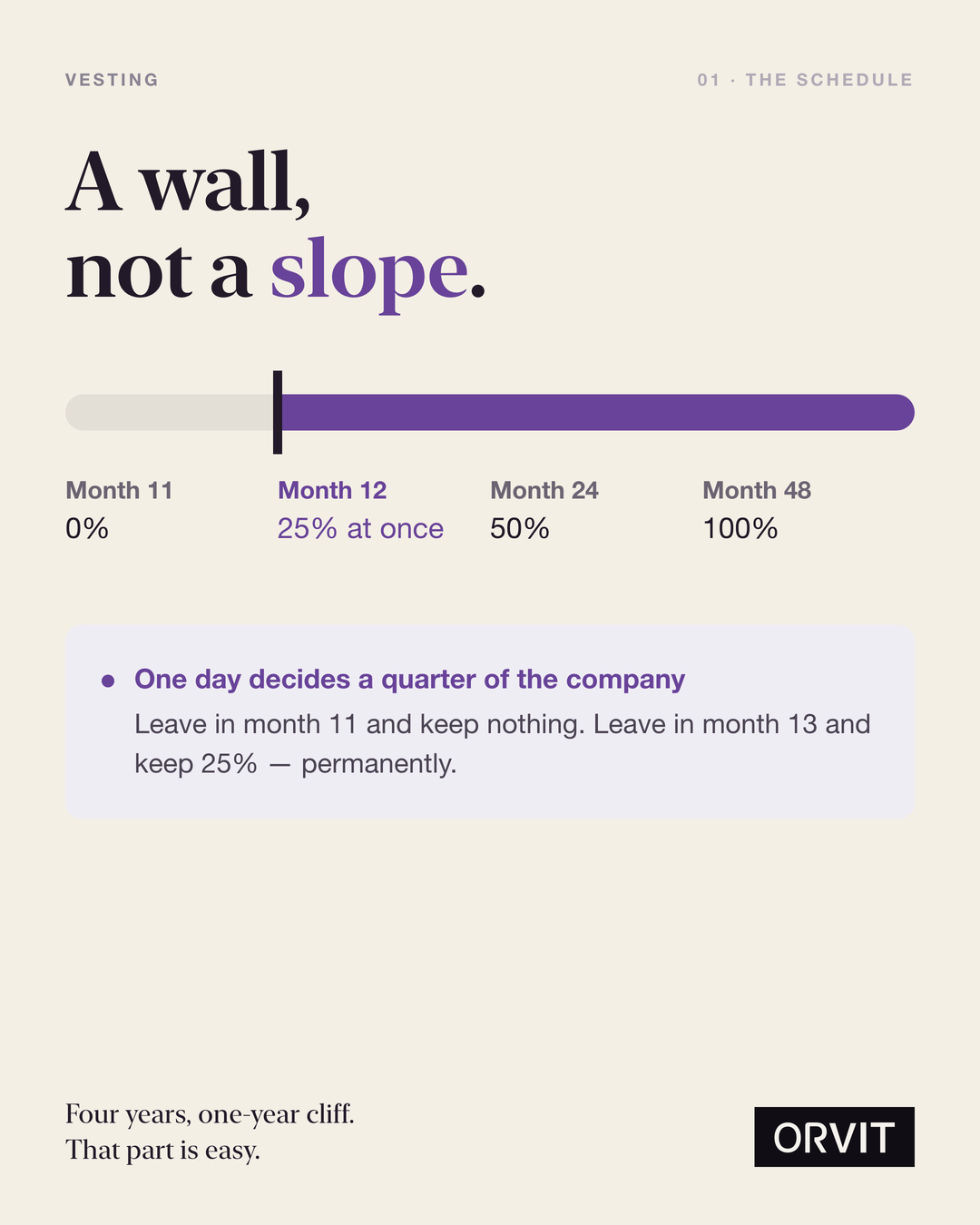
Four years, one-year cliff. You can learn the schedule in a sentence, and almost every explainer stops there — as if the hard part were arithmetic. It is not. The schedule is the easy part. What decides who ends up with what is the set of moments the schedule says nothing about.
This is the middle of a three-part arc. How to split cofounder equity ended by pointing here: Harvard and Y Combinator disagree about the number and agree completely about this mechanism. Vesting is what lets the split be wrong without destroying the company.
What vesting actually is
You and your cofounder each hold shares from the start. Vesting adds a condition to them: stay, and they become permanently yours on a schedule; leave early, and the company can buy back the part you have not earned yet.
The standard schedule is four years with a one-year cliff. Nothing vests for the first twelve months. At month twelve, 25% vests at once. After that it accrues monthly — 1/48th of the total each month — until month forty-eight. This is standard to the point that investors expect to see it, and its absence is itself a finding.
In one line: vesting is not a statement about trust. It converts a guess about the future into a claim that has to keep being earned.
The cliff is a wall, not a slope
Most people picture the cliff as a slow start. It is the opposite: a hard edge. A cofounder who leaves in month eleven keeps nothing. A cofounder who leaves in month thirteen keeps a quarter of the company, permanently, and will still hold it a decade later.
That is a violent discontinuity to have sitting inside a friendship, and it is deliberate. The first year is when most founding teams discover they were wrong about each other, and the cliff makes that discovery survivable for the company. It also creates the only genuinely awkward month in the calendar, which is worth knowing before you are in it.
The four moments the schedule does not cover
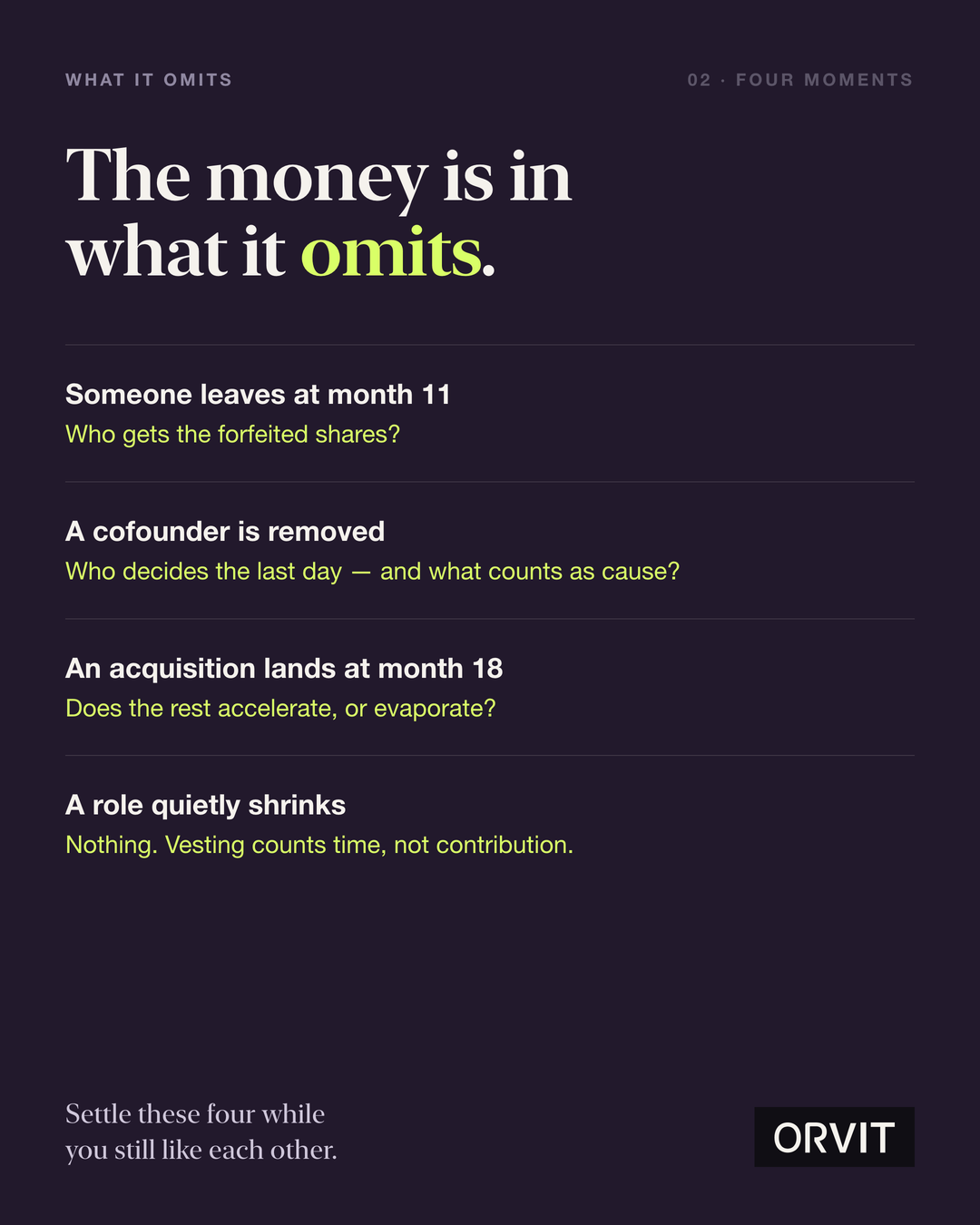
Each of these is a real event with real money attached, and none of them is answered by "four years, one-year cliff."
The fourth row is the one founders underestimate. Vesting is a clock, not a performance review. Someone who drops to evenings and weekends continues to vest at exactly the same rate as the person carrying the company, and the schedule has no opinion about it. If that asymmetry matters to you, it has to be handled somewhere else — in the roles you write down, or in a conversation you have early. It will not be handled here.
Acceleration: what happens if you sell
An acceleration clause changes the schedule when the company is acquired. There are two shapes, and the difference is not cosmetic.
Single trigger vests everything the moment the deal closes. It is the founder-friendly version and buyers dislike it, because they are purchasing a team and single trigger hands that team their money on day one. They tend to price that dislike back into the offer.
Double trigger requires two things: the acquisition and the founder being terminated within some window afterwards, usually twelve months. It protects the person who gets pushed out after the deal without making the company harder to sell. It is the market standard, and it is what experienced counsel will suggest.
This convention is US-shaped
"Four years, one-year cliff" is a convention, not a law, and it grew up around US structures. Other jurisdictions impose their own statutory minimums on option-style grants, which means the same sentence does not transfer intact. Founder share vesting is also usually implemented through a shareholders' agreement rather than an option plan — different instrument, different rules.
The practical consequence: read the schedule as a starting shape, then have someone local tell you which parts of it your jurisdiction actually permits. This is the paragraph where a blog post stops being useful and a lawyer starts.
Not legal or tax advice. Vesting, buy-back rights and founder agreements carry legal and tax consequences that differ by country and by structure. Use this to prepare the conversation, then take the outcome to a lawyer before you sign anything.
Where a founder profile fits, and where it does not
Nowhere near the schedule. Nothing about a personality profile — ours included — tells you how long a cliff should be or who decides when someone has left. Those are legal and governance questions with legal answers.
What a profile is useful for is the conversation that has to happen before the document exists. ORVIT Founder Types describe how a person tends to decide, share and commit, and the reason that matters here is narrow but real: the fourth row of the table above — the shrinking role — is almost always visible in how someone talks about commitment months before it shows up in the calendar. A profile gives you the agenda for that conversation. It does not give you a verdict, and we do not publish a compatibility score, because we could not defend one to the person it was used against. ORVIT is an astrology app built for work rather than dating — Rising and Moon signs read as working style, not romance.
Questions people ask
Does vesting mean I do not own my shares?
Usually you do own them from day one — the company simply keeps the right to buy back the unvested portion if you leave. The label differs by structure, and so do the tax consequences, which is the part to take to a lawyer rather than a blog.
Is the one-year cliff a law?
No. It is a convention, and a US-shaped one. Other jurisdictions impose their own minimums on option-style grants, so the same four-year, one-year-cliff sentence does not transfer intact everywhere.
Should we use single or double trigger acceleration?
Double is the default for a reason: it protects a founder who is pushed out after an acquisition without making the company harder to acquire. Single trigger vests everything the moment the deal closes, which buyers dislike enough to reprice around.
We already started without vesting. Is it too late?
No, and the moment to fix it is before outside money arrives — investors will ask for it anyway, and agreeing to it among yourselves is a very different conversation from being told to. If you have not had the split conversation either, start there.
The short version
Four years, one-year cliff, 25% then monthly — that part takes a sentence and everyone gets it right. The parts that decide the money are the ones nobody writes down: who declares that a cofounder has left, what happens to forfeited shares, whether an early acquisition accelerates, and the fact that a schedule counting time will happily keep paying someone whose contribution has quietly halved. Settle those four while you still like each other. The schedule is the easy part.
See how you and your cofounder work — 144 Founder Types, no account needed.