Affirmations
Daily Affirmations for Self Love That Last Past Day Three
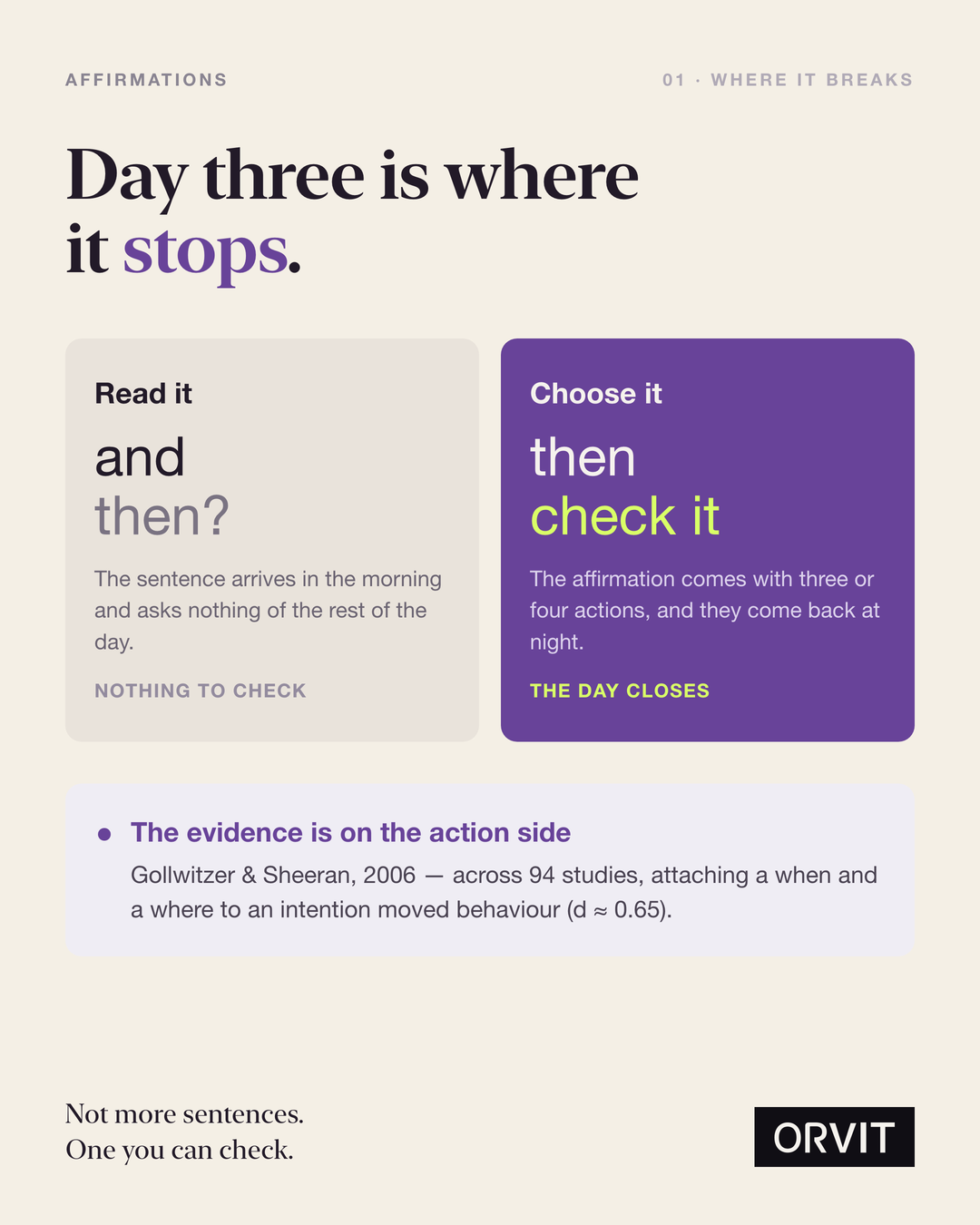
Affirmations usually last about three days. Not because you lack discipline — because reading one sentence in the morning leaves you nothing to check at night. If you have ever installed an affirmation app and muted it within a week, the break happens at the same place almost every time.
1. Daily affirmations for self love are conditional
Self-affirmation theory came from psychologist Claude Steele in 1988: when your sense of worth is threatened you get defensive, and reaffirming your worth elsewhere releases that defence. That part has replicated widely.
The part nobody puts on a graphic is the 2009 Psychological Science study by Joanne Wood and colleagues. Participants repeated "I am a lovable person" — and the ones who began with low self-esteem felt measurably worse. The paper is titled "Power for Some, Peril for Others."
So daily affirmations for self love are not dose-dependent. What matters is whether the sentence is believable from where you are standing this morning. When it is not, the effect does not drop to zero — it goes negative.
The further the sentence sits from your actual state, the louder the rebuttal. "I am not afraid" loses to "I am afraid and going anyway."
2. The real problem comes after that
Say you picked a believable sentence. You still stop on day three, because once you have read it there is nothing to do.
On this point the evidence is sturdier than the affirmation literature. Peter Gollwitzer's work on implementation intentions (1999) showed that a specific when-where-what plan converts into action far more reliably than a general resolution; the 2006 Gollwitzer and Sheeran meta-analysis pooled 94 studies and reported a medium-to-large effect (d ≈ 0.65).
An affirmation is a resolution. Without an action attached, nothing is verifiable at the end of the day — and if nothing is verifiable, there is no reason to open the app again tomorrow. That is the structural reason morning affirmations do not become a habit.
3. Why morning affirmations specifically
You could do this at any hour, so it is worth asking why morning affirmations are the ones everyone recommends. The honest answer is evidentiary: in the morning the day has not yet produced counter-evidence. Read "today goes well" at four in the afternoon and everything that already went wrong lines up to argue with it.
There is a second reason, and it is the stronger one. In the morning you still have an expectation of the day — which means the sentence can be matched to it, and the action that goes with the sentence can be decided in advance. The conditions implementation intentions require are best met before the day starts.
4. What "match the day" actually means
Matching the day does not mean checking whether today is lucky. It means deciding where the pressure is likely to land, then picking a sentence for that spot.
- A day of talking → not affirmations for self love and confidence in general, but if I get cut off, I can raise it again
- A day alone with the work → not output, but slow is not stopped
- A day with friction in it → not harmony, but uncomfortable and still valid
- A day with nothing in it → not intensity, but today is allowed to be empty
That last line matters most. Most affirmation app designs push something strong every single day, because an empty notification looks like a broken product. A strong sentence on a quiet day makes the quiet day feel like a failure. Saying nothing is happening, when nothing is happening, is the more honest move.
5. Checking it off at night closes the day
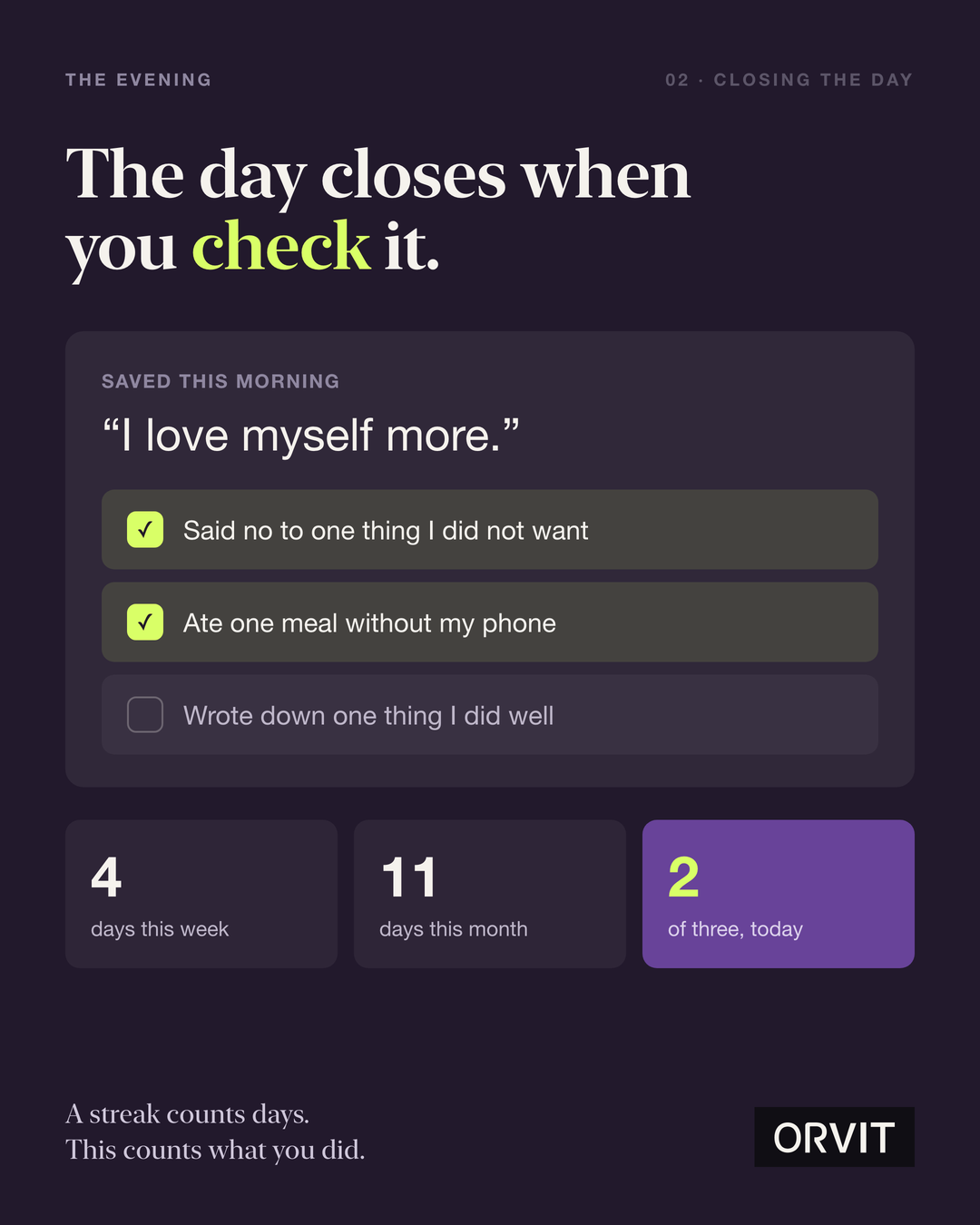
If you chose a sentence in the morning and attached an action to it, you now have something to do at the end of the day: check whether you did it, and look back.
Adding that one step changes three things.
| What the evening check changes | Why |
|---|---|
| The affirmation becomes testable | It stops being a line you read and becomes a question with an answer |
| Tomorrow gets a reason to exist | Yesterday's result is sitting there when you open it |
| You learn which sentences reach you | A month of entries shows a band narrower than you expected |
The third matters most over time. Some people find their band sits entirely in affirmations for self love and confidence; others never touch those and live in the quieter lines. Once you know your band, choosing takes ten seconds. Until you know it, you start from scratch every morning — and that fatigue is what ends the practice.
6. What to look for in an affirmation app
Search the store and dozens of results appear with roughly the same architecture: a sentence database, a notification, a widget. Some advertise 3,500 affirmations. All of that is table stakes; whether you are still using it in a month is decided elsewhere.
| Look for | Why it decides |
|---|---|
| You can choose, not just receive | Receiving only means you cannot control the distance |
| An action attaches to the affirmation | Without one there is nothing to check at night |
| There is somewhere to look back | The day has to close for tomorrow to continue |
| It admits a quiet day | An app that overstates daily spends its credibility first |
| It keeps a record | You only learn what worked by reviewing it |
Sentence count is not on that list. Even with 3,500 available you pick one, and a longer list only adds to the cost of picking.
How ORVIT builds the day
The affirmation feature in ORVIT does not stop at showing you a line. The day goes around once.
On a day you saved no affirmation, the evening review does not appear. A day you did not do is not dressed up as one you did.
Questions people ask
Do daily affirmations for self love actually work?
Self-affirmation theory has replicated since 1988. The popular version — repeat nice sentences, feel better — has not, and the 2009 Wood study found it backfires for people with low self-esteem. Treat it as conditional. The evidence is stronger once an action is attached, which is the implementation-intention literature rather than the affirmation one.
How many should I do each day?
Count is close to irrelevant, whatever the streak counter in an affirmation app implies. One sentence you can believe this morning beats ten you cannot.
Should morning affirmations be spoken out loud?
There is no settled evidence favouring speaking over writing. Writing has the practical edge: it leaves something to review at night.
What is the difference between an affirmation app and a gratitude journal?
An affirmation app points forward at a state you want; a gratitude journal points back at what already happened. Affirmations in the morning and a review at night is a common split for that reason.
What if affirmations for self love and confidence feel fake to me?
Usually the sentence is reaching too far. Changing “I am” to “I am becoming” shortens the distance immediately. If affirmations for self love and confidence still grate, starting from the action rather than the sentence is a reasonable route.
The short version
- Daily affirmations for self love work through believability, not repetition count
- An unbelievable sentence does not fail neutrally — it provokes a rebuttal
- The real reason people quit on day three is that reading leaves nothing to do
- Choose the sentence in the morning, attach an action, check it at night
- The day has to close before tomorrow has a reason to open
If the hard part is knowing what today is actually asking of you, the companion piece is how a daily vibe differs from a horoscope — the reading that section 4 draws on.
Choose it in the morning. Check it at night.
ORVIT attaches actions to the affirmation you pick, then brings them back in the evening.